
Trump administration imposes sanctions on Cuban president
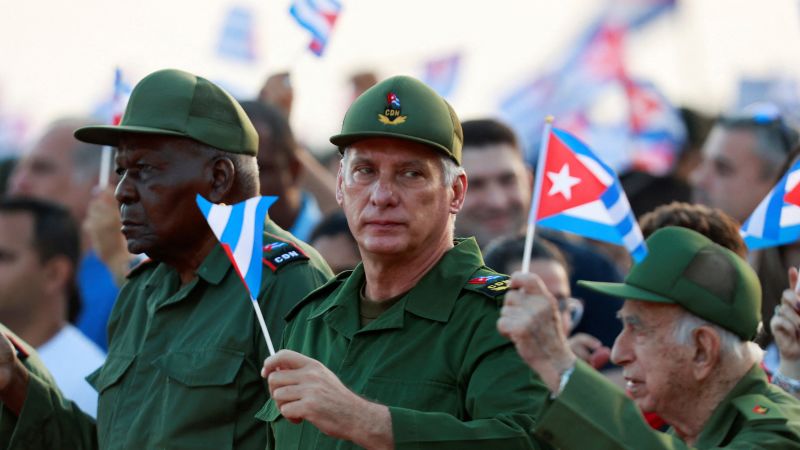
Trump Administration Imposes Sanctions on Cuban President
Trump administration imposes sanctions on Cuban – On Thursday, the Trump administration announced new sanctions directed at Cuban President Miguel Díaz-Canel, aiming to intensify pressure on the Havana government. The measures, part of a broader strategy to weaken Cuba’s economic foundation, also include entities linked to the Cuban regime, such as Raul Castro’s son, his grandson, Díaz-Canel’s spouse, and his stepson. Additionally, the Ministry of the Revolutionary Armed Forces of Cuba, along with three other state-affiliated organizations, and a Cuban-Australian mining company are targeted. These actions mark a continued effort to challenge the Cuban government’s stability and influence.
Strategic Targets and Rationale
The U.S. Secretary of State, Marco Rubio, emphasized that the sanctions are designed to isolate the Cuban regime’s network of radical actors. “We are targeting those who sustain the regime’s malicious campaign to subvert U.S. national security,” he stated, highlighting the administration’s focus on individuals and groups involved in destabilizing American interests. The decision underscores the Trump team’s belief that Cuba remains a threat through its support of leftist movements and its role in global irregular warfare.
“These sanctions target the Cuban regime’s wide-ranging and violent radical action network and the actors who implement and fund it,” Rubio said Thursday. “Beginning with Fidel Castro’s program to globalize the so-called Marxist ‘revolution,’ Havana has served as a forward operating base for global irregular warfare against U.S. interests, recruiting, training, and equipping violent left-wing militants across our region – including Marxist terrorist groups in the United States – with the ultimate goal of undermining U.S. national security.”
Rubio’s comments reflect a narrative that frames Cuba as a persistent actor in international conflicts. The sanctions are part of an intensified campaign to disrupt the country’s economic systems, with the hope of compelling political reforms. The administration has previously targeted key Cuban figures, including former President Raul Castro, and now seeks to expand its reach by including new entities tied to the current leadership.
Broadening the Economic Stranglehold
These measures build on existing efforts to cripple the Cuban economy. The Trump administration has maintained an oil embargo, restricted trade, and imposed financial penalties on entities associated with the Cuban government. The new sanctions add another layer of pressure, focusing on individuals and organizations perceived as central to the regime’s operations. GAESA, the military conglomerate overseeing Cuba’s economic infrastructure, is now under scrutiny, with potential consequences for foreign partners involved in its activities.
“Foreign banks and companies providing services to those designated are at risk of sanctions and should freeze those activities,” a separate State Department fact sheet warned. “The Trump Administration will continue to target the Cuban regime’s subversive network, those who enable its subversive operations, and those who profit while the Cuban people suffer.”
The sanctions also target a Cuban-Australian mining venture, signaling a shift in economic warfare to include private sector interests. By cutting off access to U.S. financial systems, the administration aims to increase the cost of doing business with Cuba, particularly for entities that align with the government’s policies. This approach is intended to pressure the Cuban leadership into making concessions, such as opening up to democratic reforms or reducing ties to leftist movements in the region.
Military Presence and Threat Perception
As part of its strategy, the U.S. has deployed a military carrier to the Caribbean region, raising the possibility of direct confrontation. Rubio has repeatedly stated that Cuba’s actions pose a significant threat to American security, citing its historical role in supporting revolutionary activities. The presence of the carrier is seen as a demonstration of readiness for potential military escalation, though the administration has not yet committed to an armed conflict.
Rubio’s rhetoric suggests a willingness to use military force if diplomatic efforts fail. The Cuban government, however, has not responded with immediate aggression, indicating that the administration may still be testing the limits of its leverage. The broader implications of the sanctions include the possibility of isolating Cuba further from international allies, particularly those in the Global South that have traditionally supported its socialist model.
Cuban Response and Resistance
Cuban President Miguel Díaz-Canel countered the U.S. actions by describing them as an attempt to deepen the economic blockade and heighten tensions with the United States. In a post on X, he wrote, “The aggressiveness and perversion of the U.S. government will clash with our determination to face the worst-case scenarios and resist the imperial onslaught.” This statement is translated from the Cuban embassy’s account, framing the sanctions as a continuation of U.S. imperialist policies.
Díaz-Canel’s response highlights the Cuban government’s commitment to resisting external pressures. He argues that the measures are part of a long-standing effort to undermine Cuba’s sovereignty, a claim supported by historical context. The Cuban regime has long been a target of U.S. sanctions, which have been used to limit its access to international markets and resources. This latest round, however, is framed as a direct assault on its political stability.
Secondary Sanctions and Political Leverage
The Trump administration has also warned of secondary sanctions, which could affect anyone conducting business with entities owned 50% or more by GAESA, MINFAR, or the Ministry of the Interior. This tactic is designed to widen the scope of economic pressure, ensuring that even indirect support for the Cuban government faces consequences. By targeting the regime’s financial and logistical networks, the U.S. hopes to force internal changes, such as the rise of reformist leaders within the Cuban system.
Rubio acknowledged the challenges of identifying a viable partner for transition, noting that the Cuban government has yet to produce an equivalent to Delcy Rodriguez, a former Maduro associate in Venezuela who was supported by the U.S. in her political ascent. He suggested that countries like the Czech Republic or Poland could serve as models, where stability was maintained through the preservation of key institutions. “There are specific, maybe, technocrats that we could work with,” Rubio said, “but it’s a little harder when you get higher up, because of the ideological bent that some of them have.”
Despite the administration’s focus on isolating the Cuban regime, Rubio expressed openness to negotiations that could lead to democratic reforms. “We are open to a negotiated situation that puts Cuba on a path toward democracy, prosperity, freedom, and normalcy,” he stated. However, he admitted that finding a reliable intermediary within Cuba remains a hurdle. “Ultimately, if you’re asking me, is there a singular individual right now that we would trust and rely on to lead this transition from start to finish? I can’t give you that name right now,” Rubio said during a House Foreign Affairs Committee hearing.
