
Trump admin planning to potentially put president’s image on commemorative $250 bill
Trump Admin Planning to Potentially Feature President’s Image on Commemorative $250 Bill
Trump admin planning to potentially put president – The U.S. Bureau of Engraving and Printing (BEP) is exploring the possibility of incorporating President Donald Trump’s likeness onto a commemorative $250 bill to honor the nation’s 250th anniversary. This development comes as part of broader efforts to mark the milestone, which commemorates the 250 years since the Declaration of Independence was signed in 1776. While no official announcement has been made, a Treasury Department official confirmed the initiative in a statement, noting that the BEP is actively reviewing proposals related to the commemorative currency.
The move is tied to a legislative proposal introduced by Republican Congressman Joe Wilson of South Carolina. Wilson’s office released a press statement detailing the bill, which aims to “symbolically recognize the President of the United States during the Semiquincentennial anniversary.” Although the legislation has not yet advanced through Congress, it has sparked discussions about the potential for a living leader to be featured on U.S. currency. The BEP’s statement emphasized that it is conducting “appropriate planning and due diligence” in response to the active legislation, with the possibility of producing the $250 note contingent on the bill being signed into law.
Putting a living president on currency is not a common practice, as U.S. law currently requires that individuals depicted on bills must have passed away. The Treasury spokesperson clarified that the exception to this rule would need congressional approval. This legal framework adds complexity to the proposal, as it hinges on the legislative process to override standard procedures. The BEP, which is responsible for designing and printing U.S. currency, operates as a self-sustaining agency, meaning it does not depend on annual congressional appropriations for its operations.
Design Details and Visual Inspiration
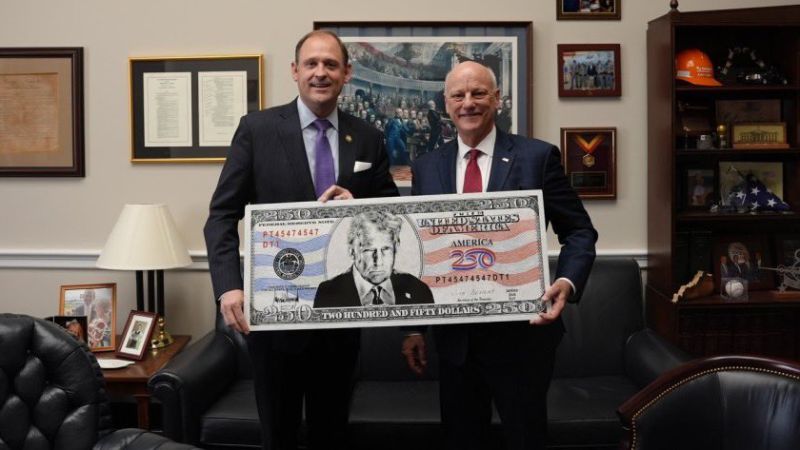
The proposed design, as outlined in reports, mirrors a mockup previously shared by GOP Rep. Andy Barr of Kentucky on X. Barr’s image, posted in January 2026, featured a stern portrait of Trump alongside the colors of the American flag, the “250” anniversary logo, and the president’s signature. The Treasury spokesperson confirmed that Trump’s signature would indeed appear on the potential currency, stating that it was a recommendation from U.S. Treasurer Brandon Beach. “Secretary Bessent will recognize the historic achievements of our great country and President Trump by adding his signature to the currency,” the spokesperson explained.
While the design has been described as a “mockup” in the press, the BEP’s involvement suggests that the plan is more than a conceptual exercise. The choice to feature Trump on the $250 bill reflects a broader trend of using currency as a medium to celebrate political figures and national milestones. However, the inclusion of a living president remains a point of debate, as it challenges the traditional practice of honoring deceased leaders on money. The visual elements of the bill, including the bold “250” emblem and the flag’s colors, are intended to create a sense of national pride and historical significance.
Support from Treasury Secretary
Treasury Secretary Scott Bessent, during a White House press briefing, expressed support for the idea of featuring Trump on the commemorative note. “There’s nothing untoward about having Trump on a commemorative bill,” Bessent said, emphasizing that the proposal aligns with the goals of celebrating the country’s heritage. However, he acknowledged that the final decision rests with Congress, as the BEP’s role is to execute the directive once legislation is enacted.
Bessent’s comments highlight the interplay between executive action and legislative authority in shaping U.S. currency. While the BEP is tasked with the technical production of the bill, the political backing from the Treasury Department signals a willingness to pursue the idea. The secretary also noted that the design process has been meticulous, with the signature of Trump being a key component that would add a personal touch to the commemorative note. This approach underscores the symbolic value of the bill, which seeks to blend historical recognition with contemporary political relevance.
Legal and Financial Implications
Despite the enthusiasm surrounding the proposal, the legal hurdles remain significant. The current statute prohibits the use of living presidents on U.S. currency, making the inclusion of Trump a unique case. The Treasury spokesperson reiterated that the BEP is following the rules and that the plan would only proceed if Congress authorizes an exception. This legal nuance adds a layer of complexity to the initiative, as it requires the approval of a specific piece of legislation to alter the standard procedure.
Financially, the BEP’s independence allows it to operate without direct congressional oversight. The agency is funded through its own operations, including the sale of currency and other services, which means it can initiate projects without waiting for appropriations. However, the commemorative bill is not expected to generate revenue, as it is more of a symbolic gesture than a commercial product. The Treasury’s focus is on ensuring the design meets both aesthetic and historical criteria, with the intention of creating a lasting tribute to the nation’s 250th year.
As the story develops, additional details have emerged about the design and its potential impact. The Washington Post reported that the visual elements of the bill closely resemble the mockup shared by Barr, suggesting that the BEP may be drawing inspiration from existing examples. This alignment with prior political designs raises questions about the broader implications of the proposal, particularly in terms of how it might shape public perception of historical events and leaders.
CNN has sought comments from the designer of the mockup, aiming to clarify the artistic and symbolic choices behind the proposed bill. The designer’s perspective could provide insight into the intent of the design, whether it is meant to celebrate Trump’s presidency, the country’s anniversary, or both. The ongoing discussion reflects the intersection of politics, design, and public memory, as the commemorative bill becomes a focal point for debate about the role of currency in national storytelling.
