From New York to Seattle to DC, more cities are picking democratic socialist leaders

Democratic Socialists Gain Momentum in Major Urban Centers
From New York to Seattle to DC – In a significant shift for local politics, Democratic Socialist candidates have emerged as key contenders in several major U.S. cities. This trend, highlighted by recent mayoral victories in Washington, D.C., Seattle, and New York City, signals a growing influence of the movement within urban democracies. The success of these leaders has sparked debates about their impact on the broader Democratic Party and the future of progressive governance.
A New Era for Washington, D.C.
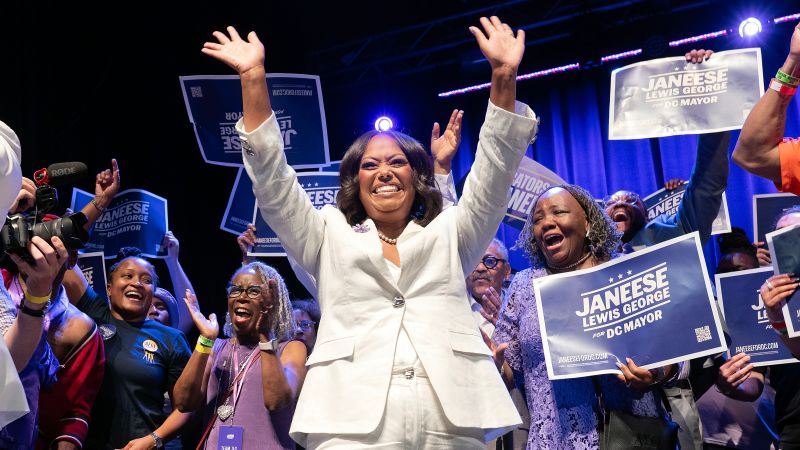
The Democratic primary for D.C.’s next mayor marked a pivotal moment for Janeese Lewis George, the Black candidate who defied expectations by securing a broad coalition. While some had speculated that her support was concentrated in affluent, White neighborhoods, the election results revealed a more inclusive base. Lewis George emphasized the diversity of her supporters, which spanned various professions and backgrounds, including community organizers, healthcare workers, and public service employees. “We’ve built a coalition that represents the entire district,” she stated, underscoring the movement’s appeal beyond traditional demographics.
“Over the past year, we assembled the most diverse coalition in this city’s history,” Lewis George said, highlighting the unity of her campaign. “We are Democrats, independents, and democratic socialists.”
This win follows 12 years of governance under Mayor Muriel Bowser, a centrist figure known for her business-oriented policies. Lewis George’s campaign focused on tackling affordability crises, such as rising housing costs and childcare expenses, which resonated with voters across income levels. Her victory is seen as a milestone for the Democratic Socialists of America (DSA), whose influence continues to expand in cities where progressive agendas align with local priorities.
Expanding Influence in the Northeast
Seattle and New York City also witnessed notable gains for the DSA. In November 2024, Zohran Mamdani and Katie Wilson, both affiliated with the movement, won mayoral elections in their respective cities. Mamdani’s momentum has not slowed, as he recently endorsed candidates in House primaries, including a high-profile contest between Rep. Adriano Espaillat and Darializa Avila Chevalier, the mayor’s favored choice.
“DSA’s electoral theory of change is really about starting from building the bench at the lowest levels of office,” Ashik Siddique, the DSA’s national political committee co-chair, told CNN.
Mamdani has been vocal about the need for the Democratic Party to modernize its approach. “The party is stuck in an old way of thinking,” he argued, warning that its failure to adapt could cost it future elections. He cited traditional primary states like South Carolina and New Hampshire as examples of where the party might falter if it doesn’t embrace new strategies. “It will fall short of 270 electoral votes because the party of the past will not be what leads us into the future,” he added.
Challenges and Cautionary Notes
Despite these victories, moderate Democrats caution against overestimating the DSA’s reach. Matt Bennett, executive vice president for public affairs at Third Way, a center-left think tank, noted that the movement’s success is largely confined to the most liberal regions of the country. “They’ve had some success in these very blue areas, but that doesn’t reflect the broader party’s position elsewhere,” Bennett said.
Analysts suggest that the DSA’s influence is strongest in areas with established progressive voting blocs. However, their policies may struggle to gain traction in Republican-leaning or swing districts. This divide raises questions about the movement’s ability to translate local successes into national political momentum.
Other Cities Take Divergent Paths
While D.C., Seattle, and New York have embraced Democratic Socialist leadership, other heavily Democratic cities have opted for different strategies. In San Francisco, voters rejected both the moderate incumbent London Breed and the progressive candidate Aaron Peskin in 2024, instead choosing Daniel Lurie, a political outsider with a background in business and philanthropy. Lurie’s focus on improving street conditions, enhancing public safety, and streamlining government operations has earned bipartisan support.
Contrast this with Chicago, where Mayor Brandon Johnson, though not a democratic socialist, has faced challenges from within his own party. Elected in 2023 with backing from grassroots organizers, Johnson has been embroiled in a lengthy budget battle and contentious negotiations over property taxes. Meanwhile, ongoing disputes between teachers and service employees’ unions, combined with staffing turmoil at the city’s school board, have weakened key support bases for progressive policies.
Strategies for Sustaining Progress
Aparna Raj, a democratic socialist running for a council seat in Northwest Washington, emphasized the importance of crafting a forward-looking vision. “Democrats must offer a positive alternative to Trump and authoritarianism,” she said. “That means people see elected officials as champions of working-class interests.” Her argument reflects a broader strategy within the DSA to broaden its appeal beyond traditional progressive strongholds.
However, the movement’s growth has not been without hurdles. In New York, efforts to extend DSA influence include supporting candidates in House primaries, such as those facing Rep. Adriano Espaillat. These actions aim to test the movement’s viability in key legislative races while challenging the mayor’s political dominance. “We’re trying to build a pipeline of leaders who can carry the message of change,” Raj explained.
As the DSA’s presence grows, its ability to balance ideological purity with pragmatic governance will be critical. While their focus on affordability and social equity has resonated in cities like D.C. and Seattle, the movement must also address concerns about electability in more moderate regions. The outcomes of upcoming races, particularly in Chicago and San Francisco, will offer insight into whether the DSA can sustain its momentum or face setbacks in the face of political fragmentation.
For now, the movement’s success continues to inspire. In Washington, D.C., Lewis George’s victory is a testament to the power of grassroots organizing. Across the country, democratic socialists are positioning themselves as a vital force in local politics, challenging the status quo and redefining what it means to be a progressive leader. As the Democratic Party navigates its evolving identity, the DSA’s growing influence may shape the future of urban governance in the United States.