
AI stocks are getting trampled. South Korean market plunges 10%
AI Stocks Are Getting Trampled. South Korean Market Plunges 10%
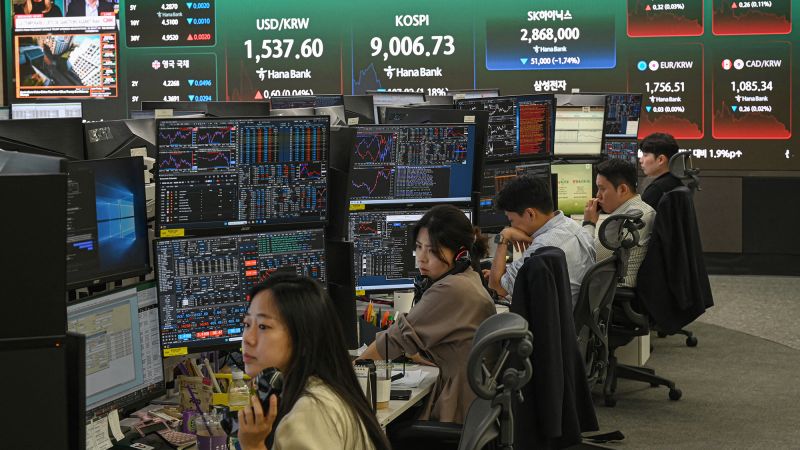
AI stocks are getting trampled South – Market turbulence resurfaced this week, with artificial intelligence once again at the heart of the chaos. A modest decline in US technology stocks on Monday spilled over into Asian markets the following day, triggering a chain reaction that led to a significant downturn in South Korea. The Kospi index, which had surged 90% this year, plummeted 10% on Tuesday, activating a circuit breaker that forced a 20-minute trading halt. This sharp drop sent shockwaves across the region, as investors scrambled to reassess their positions in response to growing uncertainty.
Leaders in Memory Chips Lead the Sell-Off
At the center of the turmoil were SK Hynix and Samsung, two of the world’s largest memory chip manufacturers. Both companies saw their shares fall more than 12% on Tuesday, dragging the broader market down with them. These giants account for roughly half of the Kospi’s total market value, making their performance a critical indicator of investor confidence. Their steep declines suggest a loss of enthusiasm for AI-driven growth, despite the sector’s rapid expansion over the past year.
The rapid sell-off was not driven by any single event, yet it felt like a coordinated effort. Some analysts speculated that the recent pullbacks in Google and SpaceX had sown seeds of doubt, even though the factors behind those drops were distinct. Google’s 5% drop was attributed to a high-profile AI leader switching companies, while SpaceX’s volatility stemmed from post-IPO jitters, a common phase for firms that experience explosive growth after their initial public offering. Still, these movements were enough to unsettle traders and fuel a broader panic in South Korea.
Fed Policy and Investor Sentiment
Another potential trigger was the Federal Reserve’s ongoing interest rate strategy. Market observers noted that the Fed’s recent pledge to intensify its fight against inflation had raised concerns about future rate hikes. Kevin Warsh, the new chair of the Federal Reserve, delivered his first press conference last Wednesday, emphasizing the central bank’s commitment to tightening monetary policy. This message, though not entirely new, was interpreted by investors as a sign that rate increases were imminent, prompting a renewed wave of selling.
“The Fed’s focus on inflation has created a climate of caution, with traders fearing that higher borrowing costs could stifle tech growth,” said one market analyst. “Even small movements in policy rhetoric can amplify uncertainty in a market already stretched thin.”
Despite these anxieties, the broader market had remained resilient. For much of the past two months, stocks had hovered near record highs, driven by optimism around AI advancements and economic recovery. However, the recent downturn has exposed vulnerabilities, as investors grapple with the idea that the sector’s meteoric rise might be unsustainable. The metaphor of a Jenga tower has emerged in financial circles, symbolizing the precarious balance between innovation and risk.
With AI companies enjoying sky-high valuations, even minor signs of doubt can spark a rapid retreat. The Kospi’s dramatic 10% fall has raised questions about whether the market is overcorrecting or simply reacting to shifting priorities. As traders and algorithms alike seek to protect gains, the sell-off has highlighted how interconnected global markets have become in the age of technology-driven speculation.
Asia-Wide Ripple Effects
The panic in South Korea quickly spread to neighboring markets. Japan’s Nikkei 225 index dropped 3.6% on Tuesday, while Softbank, a tech behemoth, fell 15% in a single session. Most other Asian indices also declined, with losses exceeding 1% across the board. This synchronized downturn underscores the shared anxieties of investors, who are now more focused on macroeconomic factors than regional developments.
Meanwhile, the US market showed signs of its own volatility. Nasdaq futures fell 2.8% on Tuesday, following a 1.3% loss the prior day. The broader S&P 500 futures dipped 1.2%, and the Dow Jones Industrial Average was projected to open 200 points lower. These movements, while not as severe as those in South Korea, indicate that the fear of a market correction is no longer confined to Asia.
Investors have been in a delicate position for months, balancing the promise of AI innovation against the risks of inflation and rising interest rates. The recent developments have forced a reassessment of this equilibrium. While AI remains a key driver of market sentiment, its influence is now being tempered by the Fed’s hawkish stance and the need for more concrete economic data to support valuations.
Broader Implications and Market Outlook
The sharp decline in South Korea’s Kospi has reignited discussions about the sustainability of the AI-driven bull market. Many analysts argue that the sector’s valuations are inflated, making it susceptible to corrections. “AI stocks have been on a rollercoaster ride, and this week’s volatility shows how fragile that momentum can be,” noted a senior financial strategist. “Traders are now questioning whether the high-flying growth trajectories of tech firms are real or artificial.”
The broader market’s behavior has also been affected. With stocks trading at or near all-time highs for much of the past two months, the recent downturn has created a sense of urgency. Investors are now more cautious, as the fear of a market top looms larger than before. The question on everyone’s mind is: How far can the Jenga tower of AI and tech optimism be pushed before it collapses?
While the Fed’s policy remains a key factor, other global dynamics are also at play. The recent ceasefire in Iran, announced by President Donald Trump in April, had initially shifted focus from geopolitical risks to AI and monetary policy. However, that momentum has since waned, leaving investors to confront the more immediate challenges of valuing the future of technology in an uncertain economic landscape.
As the market continues to adjust, the focus on AI may shift to other sectors. Yet, the recent sell-off in South Korea and the broader Asia-Pacific region has served as a stark reminder of how interconnected the global market has become. Traders are now watching for further signals, as the balance between growth and risk continues to tip in unpredictable directions.
