
Since the camera is always watching, why not snap a surveillance selfie?
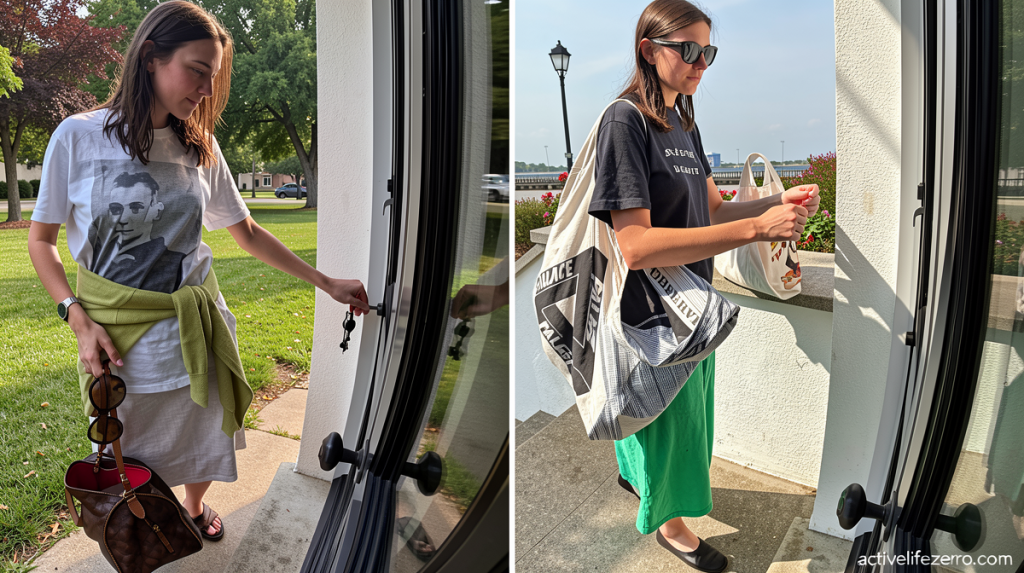
The Rise of the Surveillance Selfie: Capturing Our Own Watchers
From Security Footage to Social Media
Since the camera is always watching – Recently, English model Alexa Chung shared a collection of images on Instagram captured by a security camera positioned outside her London residence. Despite the limited resolution and narrow fisheye perspective, she appears effortlessly stylish, seemingly unfazed by the constant observation from her doorstep camera. One particular image features her in a green short-sleeved Miu Miu blouse—where the brand name remains visible despite the pixelation—paired with a taupe skirt and white ballet flats. The camera’s positioning offers viewers a glimpse into her living space, revealing welcome mats and wooden flooring.
This isn’t Chung’s first foray into this format; she has shared several doorbell camera collections over recent months. The trend may also reflect her experience with persistent media attention, suggesting that if the public is always watching, she might as well document it herself. Surveillance technology and personal photography are merging in unexpected ways.
A Growing Phenomenon
The surveillance selfie movement has spread across various platforms and settings. Shoppers photograph themselves reflected in Target’s self-checkout monitors, while drivers capture portraits using their vehicle’s rearview cameras. Morry Kolman, a software developer, created an online platform enabling users to photograph themselves using publicly accessible New York City traffic camera feeds.
With approximately twenty percent of American homes now equipped with video-capable doorbells, these devices have become popular tools for casual photography and outfit documentation. Jada Warren-Evans, an influencer marketing professional based in Los Angeles, shared multiple videos from her Ring camera in December 2025. The recordings show her returning from errands, appearing relaxed despite the camera’s presence.
When we host parties, we place a sign outside encouraging guests to pose for the camera.
Warren-Evans explained this practice in an interview, noting how guests respond enthusiastically to the invitation.
Creative Expression Meets Constant Observation
Liv Darcey, a London-based content creator, recently shared doorbell footage on TikTok with the caption “She’s always watching.” She believes people may be overanalyzing the trend.
These posts are using something that already exists in a creative way. I don’t think it’s making surveillance aspirational, it’s more about playing with frames and angles that feel less curated.
Ruby Lin, a New York designer and art director, posted Ring camera selfies on TikTok in 2024. She initially purchased the smart doorbell following a car break-in outside her apartment building.
It was about feeling safer, but I still feel really torn about it.
Lin drew inspiration from people photographing themselves in car backup cameras, finding the perspective visually compelling. She paired her videos with humorous captions like “daily greetings (and fit checks) for my assigned FBI watcher.”
Privacy Concerns Beneath the Trend
Behind the playful aesthetic lies genuine concern about increasing surveillance by private corporations. Ring, owned by Amazon, has distributed tens of millions of smart doorbells while facing criticism for law enforcement partnerships. Companies like Flock Safety have seen their cameras utilized to track individuals, including ex-partners.
Surveillance compliance core.
One commenter summarized this sentiment beneath Chung’s original post. Warren-Evans acknowledged the complexity of her relationship with the technology.
It does make me feel more safe, but I honestly don’t know who has information or access to this thing. I feel some sort of way about it. It’s weird.
Technology and the Surveillance State
Judith Donath, an artist and computer scientist who founded the Sociable Media Group at MIT Media Lab and currently serves as a fellow at Harvard University’s Berkman Klein Center for Internet & Society, views this trend as evidence of selective technology engagement.
You have the footage and it’s yours and you can do what you want with it. But it’s not just your harmless doorbell letting you know what’s going on. That information is moving out into the surveillance state.
Donath suggests that people embrace the immediate benefits of surveillance cameras while overlooking their broader implications for privacy and data collection in modern society.
