
As Trump accuses China of stealing voter data, Xi pitches Beijing as a responsible tech leader
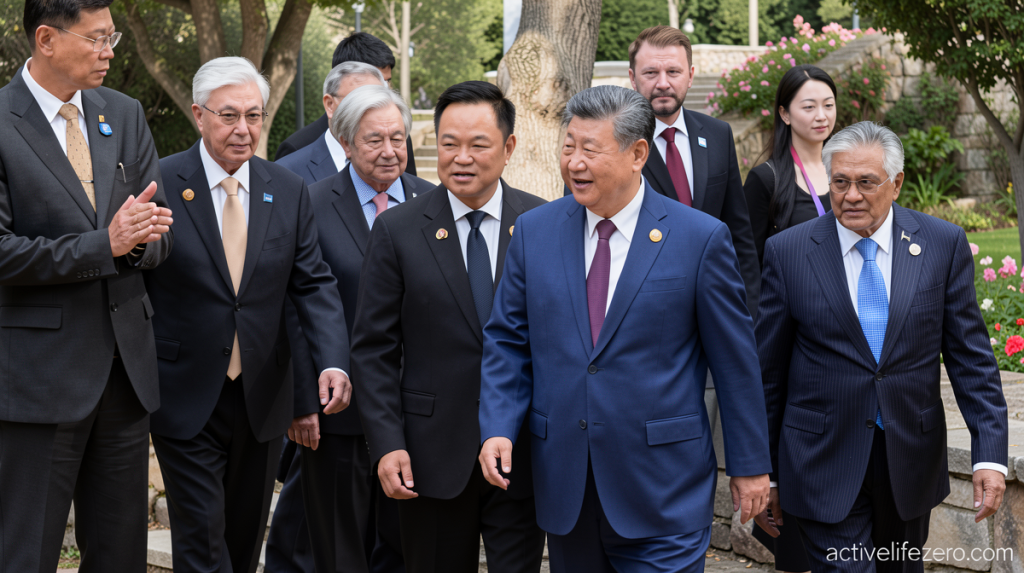
China Defends AI Leadership as Trump Accuses China of Stealing Voter Data
As Trump accuses China of stealing American election records, President Xi Jinping offered a different vision from the stage of Shanghai’s artificial intelligence summit. While Donald Trump delivered a televised address claiming Beijing had improperly obtained 220 million voter files, Xi positioned his country as a responsible global technology leader committed to ethical AI development.
“With AI advancing at a staggering speed, we must ensure its development is for positive, for good, and for humanity,” Xi declared during his opening address. “We must make its oversight and governance precise and effective and constantly refine measures to forestall loss of control.”
Contrasting Messages on the Global Stage
The timing of Xi’s speech underscored the growing tensions between the two nations. As Trump accuses China of stealing critical data to influence American elections, Chinese officials have firmly rejected these allegations. The confrontation highlights how artificial intelligence has become a central battleground in US-China relations.
Xi’s remarks represented a strategic effort to position China as the leader in establishing global AI governance frameworks. This comes at a moment of intense technological competition, with both nations concerned about AI’s capacity to exploit software vulnerabilities and reshape international power dynamics.
“With AI advancing at a staggering speed, we must ensure its development is for positive, for good, and for humanity,” Xi said in an opening address to the conference.
In his speech, Xi pushed back against what he characterized as “overstretching the national security concept in the field of AI.” Rather than adopting an isolationist approach, China has promoted the vision of AI as a “global public good,” expressing willingness to collaborate with nations worldwide in developing the technology collectively.
AI Diplomacy Takes Center Stage
Just before the conference began, China unveiled the World Artificial Intelligence Cooperation Organization, a new alliance comprising 29 nations including Russia, Indonesia, and Pakistan. George Chen, Hong Kong-based chair of digital practice at The Asia Group consultancy, explained the strategic significance: “Xi sees AI as an opportunity to get more allies to compete with the US, not just in AI technology, but also in international relations.”
According to Chen, China believes it missed opportunities to establish rules governing the global development of the internet over recent decades. However, the emergence of artificial intelligence has placed China in a considerably stronger position. “Thirty or forty years ago, China was a very poor country … but everybody knows today is different, and if AI is the new internet, China doesn’t want to miss the opportunity again.”
The Race for AI Supremacy
American companies are generally viewed as racing toward the technological frontier as their primary strategy to win the competition. Their models continue to maintain leadership in capabilities and the hardware infrastructure used for training and advancement. Nevertheless, this advantage is steadily diminishing.
When it comes to winning the AI race, Beijing is pursuing an alternative approach: applying and scaling artificial intelligence technology in robotics and automation, combined with large-scale global adoption, according to industry experts. Chinese artificial intelligence companies such as DeepSeek and Zhipu have achieved significant progress in closing the performance gap with their American counterparts.
An increasing number of users worldwide are choosing their models’ open-source format and lower operating costs compared to Silicon Valley’s offerings. Data from Our World In Data revealed that Chinese firms accounted for 20 of the daily top 50 AI models on OpenRouter in May, a platform enabling users to interact with various models, up from only five at the start of 2025. Most remaining positions are held by American companies.
Washington has recently alleged that Chinese entities were conducting “deliberate, industrial-scale campaigns to distill US frontier AI”—a process where smaller models train on larger ones to enhance their own capabilities. Earlier this month, a Chinese regulator warned that artificial intelligence systems must not be used to manipulate public opinion or undermine social stability.
