
Tricycle ambulances are saving lives in Ghana
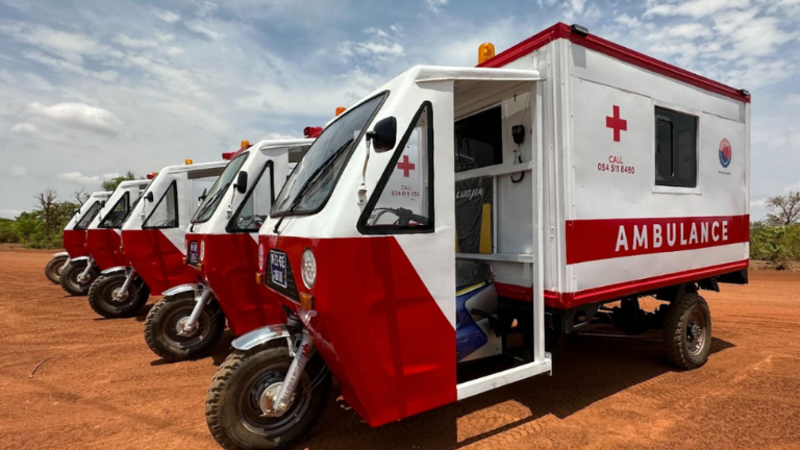
Revolutionizing Rural Healthcare: Tricycle Ambulances in Ghana
Tricycle ambulances are saving lives in Ghana – In the remote corners of Northern Ghana, where access to medical facilities is often limited, a simple yet groundbreaking solution has emerged to combat maternal mortality. The story of Billeh Rosemount, a 24-year-old farmer’s daughter, highlights the critical role of these unconventional vehicles. During a miscarriage in October 2024, Rosemount faced a life-threatening situation. “I was bleeding heavily, and the midwife couldn’t stop the flow,” she recounted. The clinic’s midwife had to rush her to a larger health center, but conventional ambulances, if available, would have taken hours to reach her. Instead, she was transported by a tricycle ambulance, a vehicle engineered to bridge the gap between rural communities and life-saving care.
Designed by the nonprofit Moving Health, these tricycle ambulances are more than just a creative twist on traditional transport. They are built with motorcycle engines and adapted to navigate the challenging, narrow roads of Ghana’s rural regions. This innovation addresses a long-standing issue: the scarcity of ambulances in areas where reliable healthcare access is already strained. Rosemount’s experience underscores the urgency of such solutions. Without the tricycle ambulance, she said, the journey to the hospital would have relied on a motorbike, a risk she described as “very, very, very difficult” to secure. “You have to beg for someone to lend the vehicle,” she added. For pregnant women in her community, the lack of transport often meant giving birth at home, where complications could prove fatal.
“Sometimes the biggest barrier to surviving a medical emergency isn’t the lack of hospitals,” said Emily Young, CEO and co-founder of Moving Health. “It’s being able to get there in time.”
Maternal mortality in Ghana remains a pressing concern, with 234 deaths per 100,000 live births recorded in 2023. While this figure has gradually declined, it still lags significantly behind the United States, where the rate is approximately 14 times lower. Sub-Saharan Africa, as a whole, accounts for roughly 70% of global maternal deaths, according to the World Health Organization. These statistics reveal the critical need for improvements in emergency transport, particularly in rural areas where distances are vast and infrastructure is unreliable.
Studies indicate that most maternal deaths occur in regions where timely care is delayed by geography. In such places, the lack of reliable transportation can mean the difference between survival and tragedy. Poverty further compounds the problem, as many families cannot afford private transport for emergencies. Moving Health’s tricycle ambulances offer a cost-effective alternative, with vehicles manufactured in the Upper West Region of Northern Ghana at one-tenth the price of standard ambulances. This affordability allows the nonprofit to scale its operations and provide essential services to underserved populations.
The initiative began as a student project at MIT in 2016, developed by Young and a group of mechanical engineering peers. It gained traction and was later established as a full-fledged organization in Ghana in 2019. By 2020, Ghana’s National Ambulance Service had only 55 vehicles to serve a population of around 35 million, highlighting the urgent need for innovative solutions. Fast forward to 2024, and the service has expanded to 356 ambulances, but Moving Health’s tricycle model continues to fill critical gaps in remote areas.
Isaac Quansah, Moving Health’s chief technology officer and country director, has a personal stake in the project. He witnessed the consequences of ambulance shortages when his wife experienced postnatal complications after giving birth to their first child. Unable to find a conventional ambulance, Quansah drove her to the hospital in a small car, forcing her to endure excruciating pain during the journey. “When I design an ambulance, I know I have a reason,” he told CNN. “A life-fulfilling purpose to help other mothers avoid the suffering my wife endured.” This experience fueled his commitment to developing a more accessible transport system.
The tricycle ambulances are stationed at community clinics and are reachable via a dedicated hotline or through local bike messengers, ensuring rapid response even in areas with limited cell service. Each vehicle is equipped with a full-length stretcher, space for a relative and a midwife, basic life support systems, and emergency birthing kits. These features enable health workers to provide critical care during transit, reducing the risk of complications for both mothers and newborns. The design also allows for flexibility, as the ambulances can carry patients up to 100 kilometers (62 miles) to regional or national hospitals for more advanced treatment.
Since its implementation, Moving Health has deployed a fleet of 31 tricycle ambulances across five districts, reaching over 230,000 people in rural Ghana. The organization reports a 64% reduction in transport time, a significant achievement in a country where two-hour journeys are common. This improvement has not only saved lives but also empowered communities to take control of their health outcomes. “The community’s feedback has been instrumental in refining the design,” Quansah explained. “We’ve upgraded the vehicles annually to better meet their needs.”
While the tricycle ambulance program is a beacon of hope, it is part of a broader effort to enhance healthcare accessibility in Ghana. Young, reflecting on the project’s journey, emphasized the importance of grassroots innovation. “We started with a simple idea—what if we could combine the durability of a motorbike with the functionality of an ambulance?” she said. The result is a vehicle that is both practical and affordable, tailored to the unique challenges of rural Ghana.
For many, these ambulances represent a lifeline. In a community where traditional transport is unreliable, the tricycle model ensures that critical care is never out of reach. As Moving Health continues to expand its reach, the organization’s vision is clear: to create a system where no mother has to face a life-threatening emergency alone. By addressing the barriers of distance, cost, and infrastructure, the tricycle ambulance program is redefining what is possible in rural healthcare.
Design and Community Impact
Engineers at Moving Health work closely with local communities to ensure the ambulances are not only functional but also culturally appropriate. The vehicles are built to withstand rough terrain, a necessity in regions where roads are often unpaved and poorly maintained. This design allows them to traverse the challenging landscape of Northern Ghana, where conventional ambulances struggle to reach. The program’s success is measured not just in reduced transport times but also in the number of lives saved and the confidence instilled in local health workers.
Quansah’s leadership in local manufacturing has been pivotal. By employing and training engineers in Northern Ghana, the organization fosters economic growth alongside healthcare improvements. This approach ensures that the ambulances are not only built but also maintained by those who understand the local needs. “We want to empower the community,” Quansah said. “This is about more than just delivering care—it’s about building sustainable solutions.”
The tricycle ambulance model has also inspired similar initiatives in other parts of the world. Its adaptability to local conditions and affordability make it a potential blueprint for other developing nations facing similar challenges. As Ghana’s maternal mortality rates continue to decline, the program stands as a testament to the power of innovation in overcoming systemic barriers to healthcare. By connecting rural populations with essential medical services, Moving Health is proving that even the most remote areas can benefit from cutting-edge solutions.
In the end, the tricycle ambulance is more than a vehicle—it is a symbol of hope and resilience. For families like Rosemount’s, it represents the possibility of survival in the face of adversity. As the organization scales its operations and refines its designs, the impact on maternal health in Ghana continues to grow. The journey from a remote village to a hospital may still be long, but with these ambulances, it is no longer a matter of life and death.
