
Russian teen Mirra Andreeva says she had to overcome so many demons inside to win the French Open
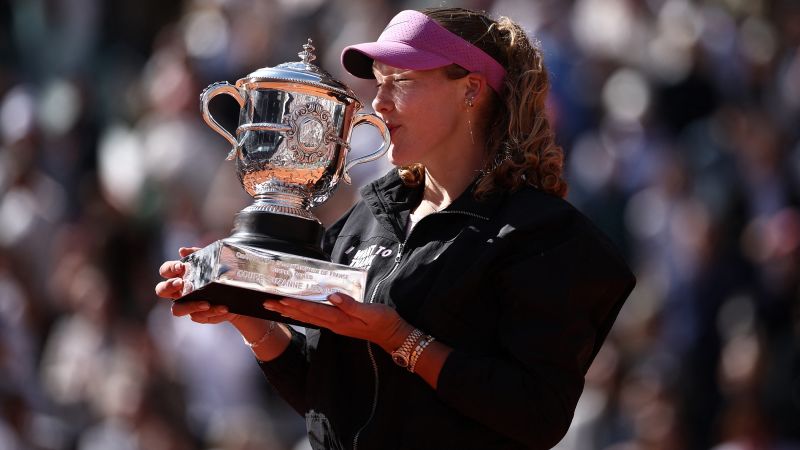
Russian teen Mirra Andreeva says she had to overcome so many demons inside to win the French Open
Russian teen Mirra Andreeva says she had – Mirra Andreeva, the 19-year-old Russian prodigy, stood in a moment of emotional release as she celebrated her historic victory at the French Open. With her hands pressed against her face and her knees slightly dirtied from the red clay, she was visibly shaken by the weight of the moment. This triumph, a culmination of years of struggle and resilience, marked her ascent as a Grand Slam champion, breaking through the challenges that had haunted her during her teenage years. The final on Saturday saw her defeat Maja Chwalinska, a 114th-ranked Polish qualifier, in a decisive 6-3, 6-2 match, solidifying her place in tennis history.
Andreeva’s journey to this moment was not just about skill but about overcoming personal demons. As she reflected on her win, she spoke about the mental battles that had tested her throughout her career. “I’ve done a lot of visualizations before,” she said, her voice trembling slightly as she recalled the countless hours of preparation. “Not just for this tournament, but for every moment I imagined success. I dreamed, I thought, I wondered when and how it would finally happen.” Her words painted a picture of a young athlete who had poured her heart into every possible scenario, only to find that the real-life experience surpassed all expectations.
“The feeling in real life is so much better than in your dreams,” Andreeva added, her tone filled with raw emotion. “I can call myself a Grand Slam champion. It’s something I never thought I’d achieve at this age.”
The psychological toll of competing at the highest level was a defining challenge for Andreeva. While her technical abilities were already impressive, particularly her attacking baseline game, the mental fortitude required to thrive in the spotlight was equally vital. Conchita Martinez, her coach and former Wimbledon champion, highlighted this aspect during the ceremony. “Her attitude is difficult,” Martinez said. “You tell her something, and maybe she’s not open to listening. But when she works hard, listens, and gives everything, she has no limits.”
Andreeva acknowledged this dichotomy, expressing her awareness of her own intensity. “I know I can be a tough cookie sometimes,” she said with a hint of self-awareness. “It’s pretty hard to put up with me, but I believe it’s necessary. My mindset is what gets me through.” This resilience was not just personal—it was a testament to the support system she had built around her, including her psychologist, who had been a constant presence from Florida. “Everything that you’ve told me, I’ve been trying to use these two weeks,” she said, her gratitude clear.
Chwalinska, the qualifier who had fought her way to the final, had also faced her own trials. The 24-year-old had once been a standout junior, competing alongside Iga Swiatek, the four-time Roland Garros champion, before her struggles with depression in 2019 began to impact her career. “Tennis is such a tough sport. It’s so individual,” Chwalinska admitted. “We start so early, and we’re basically kids when we begin. People are expecting us to behave like adults, but we’re just kids really. The pressure is huge.”
“You’re so young and talented. It’s so annoying,” Chwalinska said, a mix of admiration and frustration in her voice.
Andreeva’s victory was not only a personal milestone but also a historic one. She became the youngest woman to claim a clay-court Grand Slam since Monica Seles, who was 18 when she won her third consecutive French Open title in 1992. The achievement underscored Andreeva’s potential, as she now joined an elite group of players who had defied age and expectation to conquer the sport’s most prestigious title.
Her journey began in Siberia, where she was first discovered as a tennis talent. The move to Sochi and later to France was a strategic step in nurturing her career, allowing her to train under the best conditions and refine her game. During the trophy ceremony, Andreeva took a moment to connect with the crowd, speaking a few words of French to express her gratitude. “Thanks for your support today and over these past two marvelous weeks here in Paris,” she said, her voice carrying a sense of humility and appreciation.
“It was very important for me,” she continued, her eyes scanning the audience. “This moment isn’t just about me—it’s about everyone who believed in me along the way.”
Andreeva’s rise to prominence had already begun at 15, when she made a stunning debut at the 2023 Madrid Open. At that tournament, she became the third-youngest player to win a main draw match at a WTA 1000 event, showcasing her potential early on. Her progression since then had been steady, but the path was not without obstacles. The ongoing war with Ukraine added another layer of complexity, as Andreeva was forced to compete under neutral status without the support of her country’s flag. This led to moments of tension, such as when she faced Marta Kostyuk in the semifinals. Kostyuk, a fellow Ukrainian, refused to shake Andreeva’s hand, a gesture that symbolized the broader political divide affecting the sport.
Despite these challenges, Andreeva remained focused. “Every person doesn’t want to have a war in the world,” she said
