
More than 45 dead in Myanmar town after massive blast in building storing explosives
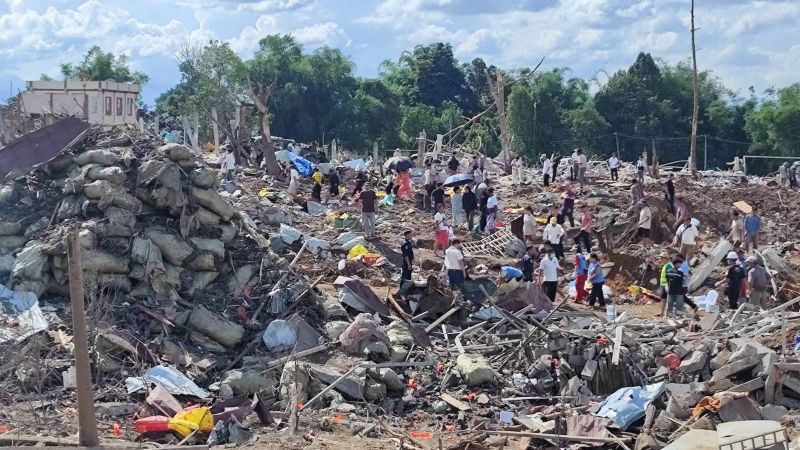
Myanmar Explosion Leaves Over 45 Dead
More than 45 dead in Myanmar – A catastrophic explosion in the town of Kaungtup, Namhkam township, has resulted in more than 45 fatalities and approximately 70 injuries, according to local rescuers and independent media reports. The blast, which occurred at midday on Sunday, destroyed a building suspected of housing explosives for mining operations. This region, located roughly 3 kilometers from the Chinese border, has been under the control of the Ta’ang National Liberation Army (TNLA), an ethnic armed group engaged in frequent conflicts with Myanmar’s central government.
Rescue Operations and Casualty Updates
Emergency teams reported that 46 bodies, including six children, were recovered by Sunday evening and sent for cremation. Over 74 injured individuals were taken to the local hospital, where staff are working to stabilize the situation. However, the exact casualty count remains uncertain, with discrepancies between sources complicating the final toll. Eyewitnesses described the explosion as causing widespread devastation, with over 100 homes near the site suffering structural damage.
“The death toll has climbed to 46, with six minors among the victims,” said a rescue worker present at the scene. “The hospital is struggling to cope, and many survivors are still missing.”
Media Accounts and Official Responses
News outlets in Myanmar, including the online publication Shwe Phee Myay in Shan State, have reported a casualty range of 50 to 55. The media shared images of dense smoke and collapsed buildings, emphasizing the scale of the disaster. Meanwhile, Chinese state television highlighted the event, noting the significant loss of life and damage to residential structures, though it did not specify the exact number of victims.
“This explosion has shaken the entire region. The numbers are alarming,” remarked a Shwe Phee Myay representative. “It’s a stark reminder of the ongoing instability and the risks faced by civilians in these areas.”
TNLA’s Explanation and Context of the Conflict
The TNLA released a statement via Telegram, claiming the gelignite stored at the site was intended for mining and quarrying. The group is conducting an investigation to determine the cause of the blast. Gelignite, a common mining explosive, can be unstable if not stored properly, increasing the likelihood of accidental detonations. The TNLA has maintained control of Namhkam since a military offensive in late 2023, part of a broader struggle against central government forces.
Since the 2021 military coup that ousted Aung San Suu Kyi’s elected government, Myanmar has experienced persistent conflict. Ethnic armed groups, including the TNLA, have fought for autonomy and against military dominance. Despite a previous ceasefire in October 2023, mediated by China, tensions continue to flare in the region.
Geopolitical and Humanitarian Concerns
The explosion has raised alarms about the safety of civilians in areas controlled by ethnic armed groups. With ongoing clashes, the storage of explosives near residential zones has sparked questions about balancing military needs with civilian protection. The incident also highlights the fragility of the ceasefire, as the TNLA’s economic department reportedly managed the explosives for mining purposes.
“The proximity of the blast to residential areas underscores the risks of conflict in this region,” noted an analyst. “The TNLA’s use of explosives for mining could have devastating consequences if mishandled.”
Experts warn that the explosion’s location near the Chinese border may have broader geopolitical implications. While China has facilitated peace talks, its relationship with the TNLA remains complex. The group’s involvement in the Three Brotherhood Alliance, a coalition of ethnic factions, points to the fragmented nature of resistance against the military. This tragedy may further strain efforts to achieve stability in Myanmar’s northeast.
