
US military leader held rare meeting with senior Cuban military officials near US base at Guantanamo Bay
US military leader held rare meeting with senior Cuban military officials near US base at Guantanamo Bay
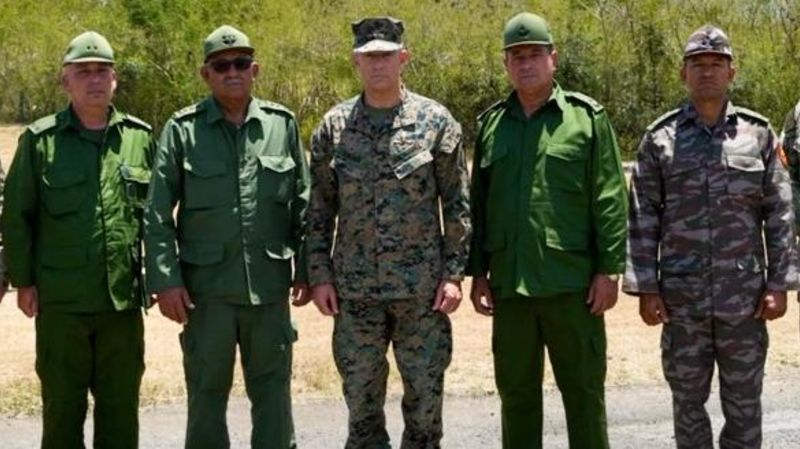
US military leader held rare meeting – On Friday, General Francis Donovan, the head of the US Southern Command, convened with high-ranking Cuban military figures, including General Roberto Legrá Sotolongo, who holds the position of Cuba’s first deputy minister of the general staff, at the perimeter of Naval Station Guantanamo Bay. This unusual gathering took place at the US military installation situated in Cuba’s southeast, marking a significant step in the evolving dynamics between the two nations. The Southern Command stated that the meeting was aimed at exchanging perspectives on security protocols, with a focus on operational readiness and the safety of personnel stationed at the base.
The Cuban Ministry of Defense issued a statement confirming that both delegations viewed the encounter as constructive. According to the statement, the discussion centered on security measures surrounding the dividing perimeter of the military enclave, and the parties expressed mutual agreement to sustain dialogue between their respective military commands. This interaction comes at a time of heightened tensions, as the US has been intensifying its military presence in the Caribbean region. The USS Nimitz carrier strike group, a formidable naval unit, recently arrived in the area, signaling a strategic reinforcement of US capabilities close to Cuban territory.
Just days prior to the meeting, Cuban President Miguel Díaz-Canel issued a warning regarding potential US military actions. He cautioned that an assault on the island would result in “a bloodbath with incalculable consequences,” emphasizing the gravity of the situation. The meeting thus appears to be part of broader efforts to address concerns about regional security and prevent escalation. It also marks the second high-level engagement between US and Cuban officials in recent weeks, following an earlier visit by CIA Director John Ratcliffe to Havana, where he met with representatives from Cuba’s Ministry of the Interior and intelligence agencies. These interactions suggest a renewed focus on diplomatic coordination amid ongoing geopolitical pressures.
“Both delegations considered the meeting to be positive, where issues related to security around the dividing perimeter of the military enclave were addressed and they agreed to maintain communication between both military commands.”
Historically, “fence line” meetings between US and Cuban military officials have taken place monthly at Guantanamo Bay. However, these exchanges had been on hold since the start of President Donald Trump’s second term, when tensions between the two nations escalated. The resumption of such meetings indicates a shift in the US strategy, possibly reflecting a balance between maintaining pressure and fostering collaboration. Donovan’s visit included a perimeter security assessment, during which he reviewed measures to protect the base and discussed force protection protocols with Cuban counterparts.
The US has long accused Cuban authorities of allowing Russian and Chinese listening posts to operate on the island, which it claims interfere with American interests in the region. CNN reported that these allegations have intensified in recent weeks, as the US applies a combination of legal, economic, and diplomatic pressures on the Cuban government. The latest round of sanctions targets key Cuban institutions, including the interior ministry and intelligence services, and Secretary of State Marco Rubio hinted at further actions, stating that “additional sanctions actions can be expected in the following days and weeks.”
One of the most notable recent developments involves the indictment of former Cuban President Raúl Castro. The Justice Department announced earlier this month that Castro, who had previously served as the leader of the country’s military, is facing charges that have been in preparation for over three decades. This legal move, combined with new sanctions, underscores the US administration’s determination to hold Cuba accountable for actions perceived as detrimental to regional stability. The indictment could have implications for Cuba’s political landscape, particularly as the current government navigates economic challenges exacerbated by the US-imposed oil blockade.
The oil embargo, enforced by the US in January, has severely impacted Cuba’s economy, leading to widespread shortages of electricity, food, and fuel. These hardships have intensified as the country grapples with the dual pressures of international sanctions and domestic economic constraints. The Cuban government has reportedly struggled to meet basic needs, with citizens facing long lines at supermarkets and frequent power outages. Analysts suggest that the US is leveraging these conditions to weaken Cuba’s political resilience and promote its own strategic objectives in the region.
While the recent meeting between Donovan and Cuban officials is framed as a positive step, it remains unclear whether it represents a lasting improvement in relations or a tactical maneuver to ease tensions temporarily. The Cuban government has maintained that it seeks to cooperate with the US on security matters, despite its economic grievances. Meanwhile, the US appears to view the dialogue as a means to assert influence and monitor Cuba’s activities. This back-and-forth reflects the complex interplay of cooperation and competition between the two nations, particularly in the context of shifting alliances and global power dynamics.
Donovan’s meeting with Cuban military leaders also highlights the strategic importance of Guantanamo Bay as a symbol of US presence in the Caribbean. The base, established in 2002, has been a focal point of Cuban-American relations, with its location just 90 miles from Havana making it a critical asset for US military operations. The discussions about perimeter security and operational readiness underscore the ongoing efforts to ensure the base remains a secure and functional hub for US forces. At the same time, the Cuban government has been working to redefine its role in the region, seeking to mitigate the effects of the US blockade while maintaining its sovereignty.
As the situation develops, the meeting near Guantanamo Bay may serve as a precursor to more extensive diplomatic engagement. However, the US’s continued pressure on Cuba, including economic sanctions and legal actions, suggests that the island’s government is unlikely to relinquish its strategic autonomy easily. The Cuban Ministry of Defense’s statement about the positive outcome of the meeting offers hope for future collaboration, but the broader context of US-Cuba relations remains marked by mutual suspicion and competing interests.
With the US military buildup and the recent indictments, the stage is set for a period of both confrontation and negotiation. The meetings between senior officials, while brief, signal an acknowledgment of the need for dialogue. Yet, the underlying tensions persist, as both nations seek to advance their respective agendas in a region that has long been a flashpoint of Cold War-era rivalries. The outcome of these interactions will likely shape the trajectory of US-Cuba relations in the coming months, with significant implications for the Caribbean’s geopolitical future.
As the Southern Command continues its efforts to strengthen security cooperation, the Cuban military’s response will be closely watched. The meeting near Guantanamo Bay may be a turning point, but it is yet to be determined whether it will lead to a thaw in relations or reinforce the existing divide. For now, the exchange between the two sides serves as a reminder of the enduring complexity of their relationship, even as new challenges emerge on the horizon.
