
Flashpoints and fury: Inside protests at a New Jersey ICE facility
Flashpoints and fury: Inside protests at a New Jersey ICE facility
A center of tension on the edge of Newark
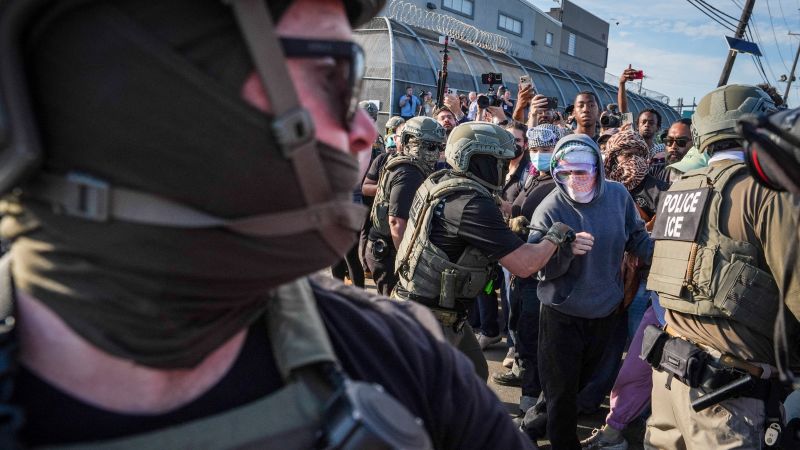
Flashpoints and fury – At a modest industrial site near Newark, New Jersey, a new wave of activity has emerged this week. Daily confrontations between demonstrators and federal officers have drawn attention to the Delaney Hall detention center, a privately operated facility with a capacity for 1,000 detainees. The protests, which have intensified in recent days, have led to calls for greater scrutiny from state lawmakers. As tensions rise, the facility is set to host a designated “protest zone” outside its perimeter, a move that reflects the growing public concern over its conditions.
Delaney Hall, situated along a high-traffic road lined with commercial trucks, has become a focal point for activists and politicians. The site’s proximity to major infrastructure has not dampened the fervor of those gathered to voice their opposition. This week’s demonstrations are part of a broader backlash against the Trump administration’s immigration policies, which have emphasized stricter enforcement and heightened security measures. Critics argue that these policies have prioritized control over compassion, leading to harsher living conditions for detainees.
Lawmakers navigate challenges to inspect the facility
Over the weekend, several officials, including New Jersey Governor Mikie Sherrill, attempted to tour the facility firsthand. However, they faced initial resistance from ICE agents, who reportedly barred entry to the building. Sherrill and other lawmakers eventually gained access, though the process was not without friction. Senator Andy Kim, a Democrat, visited the site on Monday and described the experience as a tense encounter between law enforcement and protesters.
“When I came out, I found myself in a standoff between agents and demonstrators,” Kim recounted. Despite efforts to mediate the situation, the scene escalated when agents deployed pepper spray, temporarily disorienting the senator. “I tried to bring the temperature down,” Kim said, “but the actions taken by the officers were unexpected.” The incident highlighted the volatile nature of the protests, which have seen crowds fluctuate from dozens to hundreds depending on the day.
The facility’s operators, the GEO Group, have taken steps to manage the situation. On Friday morning, they marked the sidewalk with yellow lines and placed signs warning of private property and no trespassing. A telecommunications truck also arrived, with workers installing surveillance cameras to monitor the activity. These measures signal an increased emphasis on security and control, as the GEO Group seeks to maintain order amid the unrest.
State police step in to create a protected space
Later that day, New Jersey State Police announced their intention to take over the protest area, establishing a “peaceful, protected zone” outside Delaney Hall. This decision was met with mixed reactions. The Department of Homeland Security (DHS) praised the move as a “victory for law and order,” while emphasizing that the governor had previously declined to allow state police to assist ICE agents during the protests.
“The governor’s refusal to support ICE during the demonstrations was a key point of contention,” DHS stated in a press release. Despite this, the state police have now begun working alongside federal officers to manage the crowd. The collaboration has not been without conflict, as reported by New Jersey Attorney General Jennifer Davenport. “On Friday night, troopers attempted to clear a path for vehicles exiting the facility,” Davenport said. “Some protesters resisted, using fireworks and gas canisters to disrupt the process.”
The confrontation between law enforcement and demonstrators has raised concerns about the escalation of tensions. “These images – what happened – it honestly felt very familiar,” Kim said in a
quote
. “We’ve seen it online. We’ve seen it on TV. To see it in person is surreal.” He added that the violence observed during the protests underscores a troubling pattern of normalization in American society. “What we see is, unfortunately, the normalization of this violence,” Kim said.
Health Department seeks to evaluate conditions
Meanwhile, the New Jersey Health Department has launched an inspection of the facility to address reports of inadequate living conditions. Their goal is to assess both public health and food safety standards. However, officials were restricted in their ability to conduct a full evaluation, with only a partial inspection of the food service areas permitted. “Our team was denied the ability to conduct a full inspection of the facility,” a spokesperson said. “We were limited to examining the food service operations.”
The limited access has fueled further criticism of the facility’s management. With the protests continuing, the DHS has hinted at potential adjustments to their strategy. They are considering relocating some Customs and Border Protection (CBP) officers from Newark Airport to assist with security at Delaney Hall. This move could lead to delays in air travel, adding another layer of complexity to the crisis.
A rally for ICE and the path forward
Looking ahead, a “Support ICE” rally is scheduled for Saturday outside the detention center. The event aims to showcase the administration’s perspective and counter the narratives of inhumane treatment. Despite the ongoing disputes, the facility remains a critical point of contention, with its conditions at the heart of the debate.
As the situation evolves, the balance between law enforcement and protesters continues to shift. The state police’s intervention has brought a semblance of control, but the underlying issues—such as the living standards for detainees and the role of private contractors—remain unresolved. “The protests have brought attention to a broader issue,” Kim noted. “It’s not just about one facility; it’s about the system as a whole.”
With the public eye on Delaney Hall, the challenge for authorities is to address concerns without stifling the voices of those advocating for reform. The arrival of additional resources, including surveillance equipment and state police support, suggests a coordinated effort to manage the crisis. Yet, the emotional toll on both sides is evident, as the standoff continues to unfold in the heart of a bustling industrial zone.
CNN’s Taylor Romine, Sarah Boxer, Chris Boyette, Sarah Dewberry, and Hanna Park contributed to this report.
