
Why is Trump building a ‘cage’ on the White House lawn?
Why is Trump building a ‘cage’ on the White House lawn?
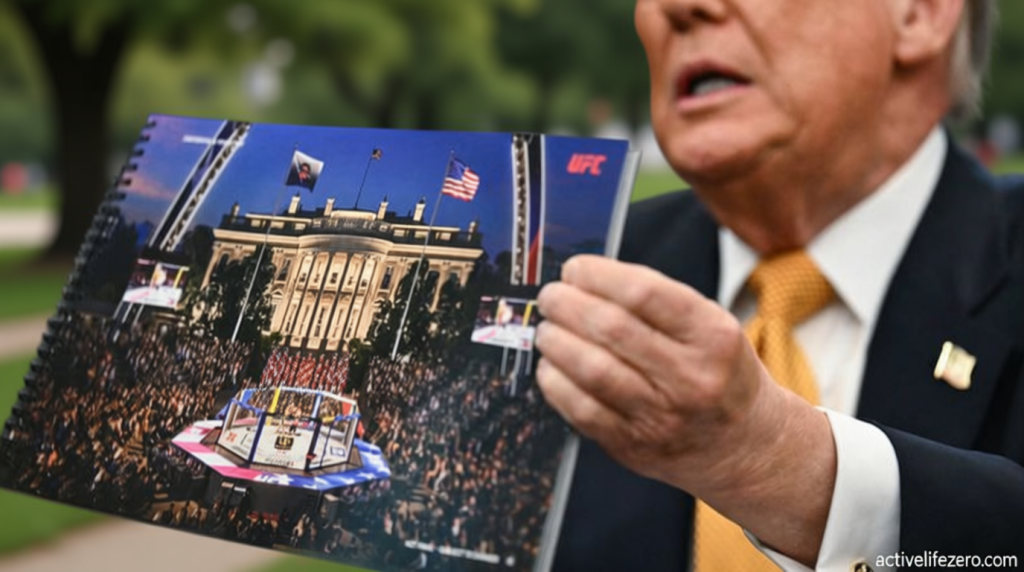
Why is Trump building a cage – Work has begun this week on constructing a unique structure on the White House South Lawn, a temporary arena designed to host a high-profile UFC event. The framework, an eight-sided enclosure encased in vinyl-coated chain-link fencing, stretches across the neoclassical facade, resembling a looping roller coaster at a theme park. This space, set for its debut on June 14, will serve as the backdrop for the UFC Freedom 250, a title match between Georgian Ilia Topuria and American Justin Gaethje. The event coincides with Flag Day and marks the 250th anniversary of the Declaration of Independence, a timing that underscores the symbolic weight of the spectacle.
For decades, the UFC has relied on the octagon—a circular, padded structure that has become synonymous with mixed martial arts. The White House cage, though temporary, mirrors this iconic design, complete with black fencing and light-colored canvas flooring. These elements, highlighted in promotional renderings shared by the UFC, are ideal for showcasing the intensity of combat. The imagery depicts the structure as the central focus, flanked by spectators seated around its perimeter. The United States Marine Band stands below the South Portico, while the stars and stripes wave in the distance, framing the event as a national celebration.
The Evolution of the Term ‘Cage’ in Sports
The word “cage” has a long history in athletics, evolving from its literal meaning of confining animals to its metaphorical use in human combat. Originally, it referred to enclosures for birds or other creatures, but by the late 19th century, the term had taken on new life in sports. In baseball, it described the area where players practiced batting, while in hockey, it denoted the goal. Even earlier, basketball games were sometimes played within netting or wire-mesh enclosures, earning players the nickname “cagers” for decades afterward.
However, the UFC’s octagon represents a more specialized use of the term. Its design originated from a need to elevate the drama of combat, creating a space that felt both contained and explosive. This concept traces back to the wrestling cages of the 1930s, which were used to heighten the spectacle of scripted matches. According to Michael Thomsen, author of “Cage Kings: How an Unlikely Group of Moguls, Champions & Hustlers Transformed the UFC into a $10 Billion Industry,” the wrestling cages introduced the idea of a confined arena where the chaos of fighting could be amplified.
“Putting a match in a cage told spectators that the mayhem couldn’t be contained within an ordinary wrestling ring.”
By the 1980s, steel had replaced chicken wire in these enclosures, offering greater durability and visual impact. The octagon’s design, however, took shape in the early 1990s, when Art Davie—a former car salesman turned advertising executive—pitched a bold idea to Tecate beer. His vision was to create a TV series that would pit fighters from different disciplines against each other, aiming to captivate younger audiences with its intensity.
Davie’s concept was inspired by a magazine article about Rorion Gracie, a Brazilian jiu-jitsu master whose family had pioneered no-holds-barred fighting. At the time, Gracie was making a name for himself in Hollywood as a stunt coordinator and celebrity trainer, offering a $100,000 open challenge to any American willing to face him. Davie, captivated by Gracie’s reputation, reached out to him about the project. Together, they envisioned a structure that would set the UFC apart from traditional boxing rings.
Davie’s initial ideas were as imaginative as they were ambitious. In a VICE TV documentary, he mused about incorporating a moat with sharks, suggesting, “We could put sharks in it.” He also considered electrifying the outer ring to add an extra layer of excitement. While Tecate’s US importer initially dismissed the proposal, Davie remained undeterred. He quit his job and invested his savings to bring the ultimate fight night to life, transforming the idea into a reality that would redefine combat sports.
The Symbolism of a National Stage
Trump’s decision to host the UFC Freedom 250 on the White House lawn is as much about symbolism as it is about entertainment. By placing the octagon in a historically significant location, the event becomes a statement about the blending of American heritage and modern sports culture. The arena’s placement near the South Portico—a site steeped in presidential history—adds layers of meaning to the occasion, connecting the fight to the nation’s founding ideals.
Yet, the cage’s presence on the White House lawn also raises questions about the intersection of politics and combat. Trump, known for his bold persona, has long embraced the UFC as a platform for his brand. His recent trip to Miami to watch a championship bout, where he embraced UFC CEO Dana White and observed the action through the wire, signals a deepening commitment to the sport. This event, therefore, is not just a celebration of the 250th anniversary of the Declaration of Independence but also a showcase of Trump’s influence and vision in the world of mixed martial arts.
Despite its temporary nature, the White House cage is designed to leave a lasting impression. The octagon’s padded canvas floor and enclosed structure are tailored to maximize the visual and emotional impact of the fight. Spectators will be arranged around the arena, creating an immersive experience that highlights the tension between human strength and the boundaries of the cage. The United States Marine Band, a staple of national events, will add a ceremonial touch, reinforcing the event’s connection to American tradition.
As the construction progresses, the White House lawn transforms into a battleground of sorts, where the energy of the fight is matched only by the historical significance of the setting. The cage, once a simple enclosure, now stands as a symbol of the UFC’s evolution and its ability to adapt to new stages, even one as iconic as the White House. Whether viewed as a celebration of the nation’s past or a bold statement for its present, the event encapsulates the UFC’s role in modern entertainment and its growing influence on cultural landmarks.
From its roots in wrestling cages to its current form as a global sports phenomenon, the UFC has continually redefined what a fighting arena can be. Trump’s decision to bring this concept to the heart of Washington, D.C., reflects both the sport’s popularity and the president’s desire to make a statement. As the date approaches, the White House becomes a stage where history and high-octane action collide, proving that even the most traditional of spaces can be transformed into a symbol of modernity and spectacle.
