
After 250 years, Revolutionary War-era soldiers finally laid to rest in upstate New York
After 250 Years, Revolutionary War-Era Soldiers Finally Laid to Rest in Upstate New York
A Commemorative Journey Through Time
After 250 years Revolutionary War era soldiers – On Memorial Day weekend, a symbolic culmination of history unfolded as 40 Revolutionary War-era soldiers were given their final resting place in the serene southeastern region of the Adirondack Mountains. This act of remembrance, long delayed by time and neglect, marked the end of a journey that began with the unearthing of their remains in 2019. For decades, these soldiers’ stories remained buried, both literally and figuratively, until a chance discovery during construction work in Lake George revealed their skeletal remains. Now, their legacy is being honored with a solemn procession and a reinterment ceremony that bridges the past and present.
Unearthing a Forgotten Chapter
The breakthrough came when a construction site near Lake George, New York, yielded unmarked graves containing centuries-old bones. Among the artifacts recovered from the frozen earth were pewter military buttons from the First Pennsylvania Battalion, a unit formed in 1775. These finds, coupled with historical records, allowed experts to trace the remains back to the Revolutionary War era. The site, once a makeshift smallpox hospital, had served as a temporary resting place for soldiers during the 1775–1776 Quebec Campaign, a pivotal but often overlooked phase of the American Revolution.
According to Lisa Anderson, the museum’s curator of bioarchaeology, the graves were not just a testament to the soldiers’ sacrifice but also a reflection of the harsh realities of wartime life. “They were predominantly young, in their teens and twenties, likely recent recruits in the fight for independence,” she explained in a statement. “Among them was even a woman and a child, a haunting reminder of the toll war exacts on families.” The discovery, she added, provided a rare glimpse into the lives of those who fought and died during the nation’s struggle for freedom.
From Construction Site to Memorial Ceremony
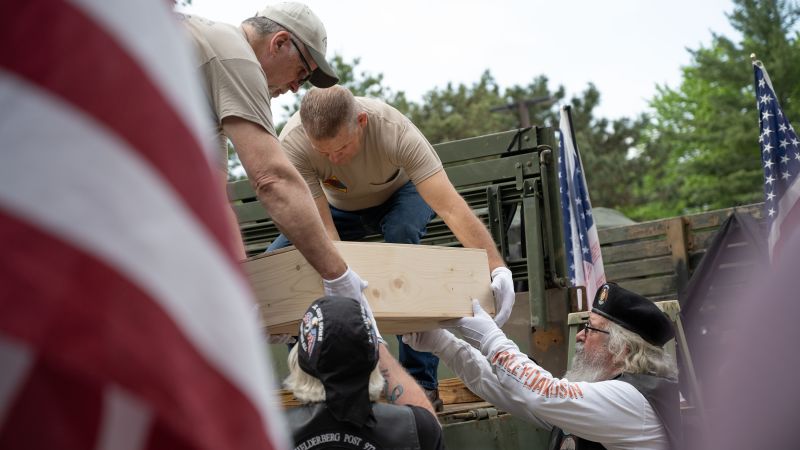
What started as a routine excavation turned into a historical revelation. The soldiers’ remains, previously scattered and forgotten, were carefully retrieved by former service members who carried them in small pine boxes. The procession, which stretched 60 miles, was marked by vintage military vehicles draped in black funeral bunting and American flags. Along the route, residents gathered on sidewalks to wave flags and pay tribute to the honored dead. The event, held at the new Repose of the Fallen memorial in Lake George Battlefield Park, ensured that these individuals received the ceremonial honors they might have never anticipated during their lifetimes.
The location of the reinterment holds particular significance. Lake George, long associated with the French and Indian War, now stands as a site where the American Revolution’s echoes are being heard once more. “This entire episode has largely remained a footnote in history, especially in Lake George, overshadowed by the dramatic events of the French and Indian War,” Anderson noted. The reconstruction of Fort William Henry, the 1755 British colonial fortress, serves as a physical link to the region’s complex past, yet the soldiers’ remains were a forgotten chapter until recently.
Revealing Lives Through Archaeology
Experts spent months painstakingly sifting through soil to recover as many remains as possible. From the 44 skeletons and fragments unearthed, scientists pieced together details about the soldiers’ lives and deaths. Arm bones, pelvises, and femurs hinted at their physical conditions and the injuries they sustained. Anderson described the smallpox hospital at Fort George as a place more for containment than care, where the sick were isolated to prevent the spread of disease. “Conditions at the hospital were not like we imagine hospitals today,” she said during a recent lecture. “It was essentially a place to warehouse the afflicted, with minimal resources and medical support.”
The soldiers’ fate was tied to a failed Continental Army campaign aimed at capturing Quebec and turning it into the 14th American colony. Though the mission ultimately ended in retreat, their sacrifice remains a cornerstone of the nation’s early history. Jennifer Saunders, the museum’s executive director, emphasized that the reburial was more than a ritual—it was an act of restoring dignity and ensuring their stories would not be lost to time. “As our nation approaches its semiquincentennial, their reinterment carries profound meaning,” she stated. “It’s a tribute to their service and a recognition of the sacrifices made to secure independence.”
A Legacy of Remembrance
The ceremony on Friday was a poignant reminder of the enduring connection between past and present. Attendees, including historians and local community members, gathered to witness the solemn transfer of the soldiers’ remains to a permanent resting place. The event coincided with the 250th anniversary of the Declaration of Independence, a fitting backdrop for honoring those who fought in the early years of the American Revolution. “They are remembered not as historical fragments, but as individuals who served and sacrificed,” Saunders added, underscoring the importance of preserving their identities.
For Anderson, the discovery and reburial represent a deeper mission. “It is a privilege to help share their stories,” she said. The process of uncovering these narratives has required years of analysis, combining archaeological evidence with archival research. Each find, from the military buttons to the smallpox hospital’s location, adds a layer to the understanding of this critical period. The soldiers’ remains, once overlooked, now serve as a tangible link to the courage and hardship of those who laid the foundation for the nation’s freedom.
Community and Historical Reckoning
The reburial ceremony was not just a tribute to the soldiers but also a moment of reflection for the local community. For many residents of Lake George, the event offered a chance to connect with their heritage and recognize the contributions of those who came before them. “This is a moment to honor the past while looking forward to the future,” one attendee remarked. The new memorial, located within Lake George Battlefield Park, is designed to educate visitors about the soldiers’ experiences and the broader context of the Revolutionary War.
As the nation commemorates the 250th anniversary of the American Revolution, the reinterment of these soldiers highlights the importance of preserving historical memory. Their journey from forgotten remains to a dignified farewell underscores the value of uncovering and celebrating the sacrifices made during the fight for independence. The ceremony, with its blend of solemnity and celebration, ensured that these individuals would no longer be just bones in the earth but living stories of courage and resilience.
A New Beginning for the Fallen
The process of restoring the soldiers’ legacy began with the initial discovery in 2019 and has since evolved into a comprehensive effort to honor their memory. From the moment their remains were found, a team of archaeologists and historians worked tirelessly to analyze and contextualize their history. The meticulous work involved not only identifying the individuals but also understanding the circumstances of their deaths. “Each skeleton tells a story, and every artifact adds a piece to the puzzle,” Anderson reflected. The culmination of this effort, now realized in the form of a formal reinterment, marks a significant step in ensuring that these soldiers are remembered as part of the nation’s founding narrative.
As the sun set on the Memorial Day weekend, the final act of remembrance brought closure to a long-awaited chapter. The soldiers, who once fought for a cause that shaped the United States, now rest in a place that symbolizes their enduring impact. Their story, once buried in the earth, has resurfaced to remind us of the price of freedom and the importance of remembering those who paved the way. With the Repose of the Fallen memorial standing as a testament to their service, the community and historians alike can now celebrate the lives of these Revolutionary War-era soldiers in a way that honors their legacy and the values they stood for.
