
These unassuming wedding photos poke holes in the patriarchy
These Unassuming Wedding Photos Challenge the Patriarchy
A Photographer’s Rebellion in the 1993 Summer
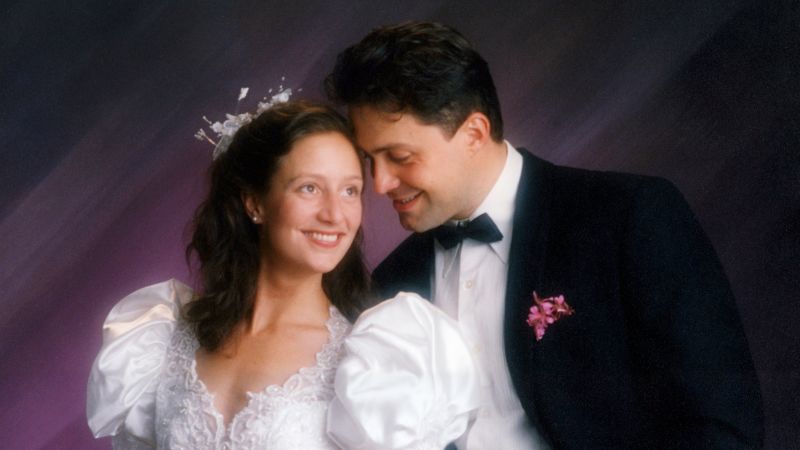
These unassuming wedding photos poke holes – In the summer of 1993, Vibeke Tandberg, a Norwegian artist and student, transformed the concept of marriage through a bold experiment. She donned a puff-sleeved gown adorned with lace, a style popularized by Princess Diana, and posed for photographs as if she were a traditional bride. Yet, unlike conventional wedding shoots, there were no ceremonies, no priests, and no wedding guests. Instead, Tandberg stood before a purple backdrop in a professional photography studio, her presence flanked by nearly a dozen men who had met her at a Bergen bar. These men, her husbands, were not real partners but carefully selected figures from her favorite student hangout, a part of her artistic exploration of marriage.
The Art of Subversion: A Feminist Perspective
“Bride,” Tandberg’s seminal series, began as a critique of the wedding photography genre, which often reduces women to a singular, idealized image—typically the white dress. By contrast, she aimed to challenge that narrative, creating a more empowering vision of matrimony. “I was choosing the men, I was the center of the photograph,” she explained during a video call from Bergen. This deliberate shift in agency emphasized her role as the only consistent figure in the images, while the men—variously dressed and posed—acted as temporary companions.
“The meaning of it was to have it confirmed, verified. Real photographs, real events becoming truth through media.”
From Bar Stools to Picture Frames: The Making of a Series
The photos were captured over two days in a Bergen studio, where Tandberg borrowed her wedding attire from a local bridal shop. The agreement included a clause allowing the shop to use the images for advertising, a detail that underscored the commercial and artistic duality of her project. Her bouquets were crafted from flowers plucked from public city beds, a nod to the everyday materials that shaped her vision. Meeting her “husbands” was effortless, as the bar in Bergen had become her second home during student years. “It was my student years,” she remarked, “so I spent six days a week there.”
The collaborative nature of the project marked a departure from Tandberg’s usual solitary approach. “I always worked alone, so I thought: ‘Let’s make, like, a party out of it,’” she said. While she entrusted a commercial studio with the technical execution, the photographer treated the session like a typical wedding shoot, choreographing poses with the precision of a professional. “For him, it was business as usual,” Tandberg noted. “I just got the exact pictures he would do of anyone else getting married.”
The Media’s Role in Shaping Perception
Initially displayed at Fotogalleriet in Oslo, the series was meant to spark further reflection. Tandberg submitted a different couple photograph to several regional Norwegian newspapers, presenting them as genuine wedding images. The newspapers, unaware of the trick, published the photos with formal announcements, often on the same day or the next. “The meaning of it was to have it confirmed, verified,” she said, highlighting how media validation turned her artistic statement into a public phenomenon. The Swedish photography magazine Index was the first to uncover the stunt, followed by national outlets that sought to investigate the deception.
“When the press is fooled, they really want to get on top of it,” Tandberg observed. This media frenzy propelled her to national attention, yet it also revealed the emotional weight of cultural traditions. The men she recruited, once perceived as rugged and macho, found themselves moved by the moment. “Some of them would actually tear up at the sight of me,” she said, recalling how their own vulnerability mirrored the audience’s reactions. “We were all young, no one was married, no one had done this.”
Truth in Photography: A Fractured Reality
Though the project was designed to question the authenticity of wedding photography, Tandberg’s own experience with the images revealed a deeper truth. “When I first saw myself in this wedding outfit, I thought, ‘Oh my God,’” she admitted. The moment stirred an unexpected connection to the very institutions she had sought to deconstruct. Her photographs, meant to mock the patriarchal ideals of purity and dedication, had instead become symbols of a universal desire for validation. “It touched me somehow,” she reflected, underscoring the emotional resonance that transcended her initial artistic intent.
The series, now part of an exhibition at Kode Bergen Art Museum, remains a powerful commentary on the intersection of art, media, and societal norms. Tandberg’s choice of a bridal gown—a garment steeped in traditional symbolism—served as a provocative contrast to the fabricated scenarios. “I was choosing the men, I was the center of the photograph,” she reiterated, emphasizing how the setup allowed her to reclaim the narrative. In doing so, she questioned the boundaries between reality and performance, challenging viewers to reconsider what they see as “truth” in imagery.
Legacy in a Digital Age
Tandberg remains resolute about the relevance of her work today. “A series like ‘Bride’ wouldn’t work in the age of social media and AI,” she stated, where the line between authentic and curated content blurs. “We don’t have the same belief in what we read and see and hear. We are skeptical.” Yet, the project’s impact endures, sparking conversations about the power of photographs to shape identity and societal expectations. As the first to expose the stunt, Index’s role in the narrative highlights the media’s ability to both create and dismantle myths, a duality that Tandberg’s work exemplifies.
“Bride” is more than a critique of wedding photography—it’s a testament to the enduring appeal of ritual and the human need for narrative. Even as the series pokes holes in patriarchal structures, it also captures the beauty of a moment that felt real, if only briefly. Tandberg’s art invites us to question not just the images we consume, but the stories they carry, and the truths they promise to reveal.
