
How Many Calories Should I Eat to Gain Muscle? Calculating Your Needs

How Many Calories Should I Eat to Gain Muscle? If you want to build more muscle, knowing how many calories to eat is key. You have to find the right balance between how much you eat and how much you burn. We will explore what factors affect how many calories you need. Then, we’ll show you how to figure out the best amount to eat for gaining muscle.
By the end, you’ll know exactly how to feed your muscles for growth. Let’s figure out your ideal calorie intake for building muscle!
Understanding Calorie Needs for Muscle Gain
To build muscle, we must eat more calories than our body uses every day. These extra calories give us the energy to grow and repair muscles. But, the exact amount of calories we need varies. It depends on our age, gender, how active we are, and our body’s current state.
Factors Affecting Calorie Requirements
Our need for calories to gain muscle can be influenced by a few key things:
- Metabolism: Our body’s natural calorie-burning rate can change. This change depends on things like how old we are, our gender, and our body’s current state.
- Activity Level: The calories we burn go up if we’re more active. So, being active means we need more calories to help us gain muscle.
- Muscle Mass: Having more muscle makes our body burn more calories, even when we’re not doing anything. This is because muscles need lots of energy.
- Genetics: Some people naturally burn calories faster or slower. This can also affect how many calories we need to eat to gain muscle.
The Role of a Calorie Surplus
To increase muscle, we need a calorie surplus. This means taking in more calories than we use. The extra energy helps our muscles grow and get stronger. The perfect surplus to aim for is about 300-500 calories over what we normally eat. But, this number can change for each person.
Knowing what impacts our calorie needs and the value of a calorie surplus helps us plan our meals better. This way, we can reach our muscle-building targets more effectively.
Calculating Your Basal Metabolic Rate (BMR)
Start by figuring out your basal metabolic rate (BMR) to know how many calories you need to gain muscles. Your BMR is the calories you burn when your body is at rest.
This number is crucial for understanding your energy needs and the extra calories you should eat to gain muscle.
To find your BMR, you can pick from many formulas. The Harris-Benedict and Mifflin-St Jeor equations are popular. They use your age, sex, height, and weight to give you a custom BMR estimate.
Here’s a simple way to get your BMR:
- First, tell if you’re a man or woman. The formula changes a bit based on gender.
- Then measure your height in centimeters and weight in kilograms.
- Put your age, height, and weight into the right BMR equation below:
- For men: BMR = 88.362 + (13.397 x weight in kg) + (4.799 x height in cm) – (5.677 x age in years)
- For women: BMR = 447.593 + (9.247 x weight in kg) + (3.098 x height in cm) – (4.330 x age in years)
- After plugging in the numbers, you’ll get your basal metabolic rate.
With your BMR in hand, you can figure out your total daily energy expenditure (TDEE). This helps you set the right calorie surplus for gaining muscle.
| BMR Calculation Example | Value |
|---|---|
| Gender | Male |
| Age | 30 years |
| Height | 130 cm |
| Weight | 80 kg |
| BMR Calculation | 88.362 + (13.397 x 80) + (4.799 x 180) – (5.677 x 30) = 1,791 calories |
Determining Your Total Daily Energy Expenditure (TDEE)
After you find your basal metabolic rate (BMR), it’s time to calculate your TDEE. Total daily energy expenditure (TDEE) shows how many calories you need. It includes your daily activities and workouts.
Factors Affecting TDEE
Many things can change your TDEE. These factors determine how many calories you should eat to gain muscle. It’s important to know them for accurate TDEE calculation.
- Body weight and composition: More muscle means resting burns more calories.
- Activity level: Being more active increases your daily calorie needs.
- Exercise intensity and duration: How you work out affects your TDEE.
- Metabolism: Fast or slow metabolism changes how many calories you use.
- Age and gender: Age and gender can alter TDEE through muscle and metabolism changes.
Understanding these aspects helps in setting a correct calorie surplus for muscle growth.
| Activity Level | TDEE Multiplier |
|---|---|
| Sedentary (little or no exercise) | 1.2 |
| Lightly Active (light exercise 1-3 days/week) | 1.375 |
| Moderately Active (moderate exercise 3-5 days/week) | 1.55 |
| Very Active (heavy exercise 6-7 days/week) | 1.725 |
| Extremely Active (very heavy exercise, physical job, or training 2x/day) | 1.9 |
Knowing what affects your TDEE and selecting the right activity level multiplier is crucial. It’s key to achieving your muscle-building objectives by adjusting your calorie intake.
Setting a Calorie Surplus for Muscle Growth
Knowing your TDEE is just the start. Next, you need to boost your caloric intake to create a calorie surplus. This will give your body the extra energy it needs to grow new muscle. But, it’s important to do this without adding too much body fat.
For most people, aiming for a calorie surplus of 300 to 500 calories above your TDEE is best. This level hits the sweet spot. It helps your muscles grow with the right amount of calories, but not too much to cause a lot of fat gain.
To set a calorie surplus for muscle building, here’s what you do:
- Find out your TDEE from the earlier section.
- Then, add 300 to 500 calories to this TDEE. This becomes your daily goal to support muscle growth.
- Make sure to eat more proteins and carbohydrates to fuel your muscles.
- Keep a close eye on your progress. Adjust your calorie surplus as you see changes in your body.
Finding the right calorie surplus for muscle gain is crucial. Too many calories can lead to a lot of fat. But not enough will slow down your muscle growth. So, getting the perfect amount of surplus for your body is the goal.
| Calorie Surplus | Potential Muscle Gain | Potential Fat Gain |
|---|---|---|
| 300 calories above TDEE | 0.5 – 1 lb per month | 0.25 – 0.5 lb per month |
| 500 calories above TDEE | 1 – 2 lb per month | 0.5 – 1 lb per month |
This table gives you an idea of the muscle and fat gains with different calorie surplus levels. It’s a great tool to figure out the optimal calorie surplus for muscle growth. Find the right balance based on your goals and body.
Macronutrient Breakdown for Muscle Building
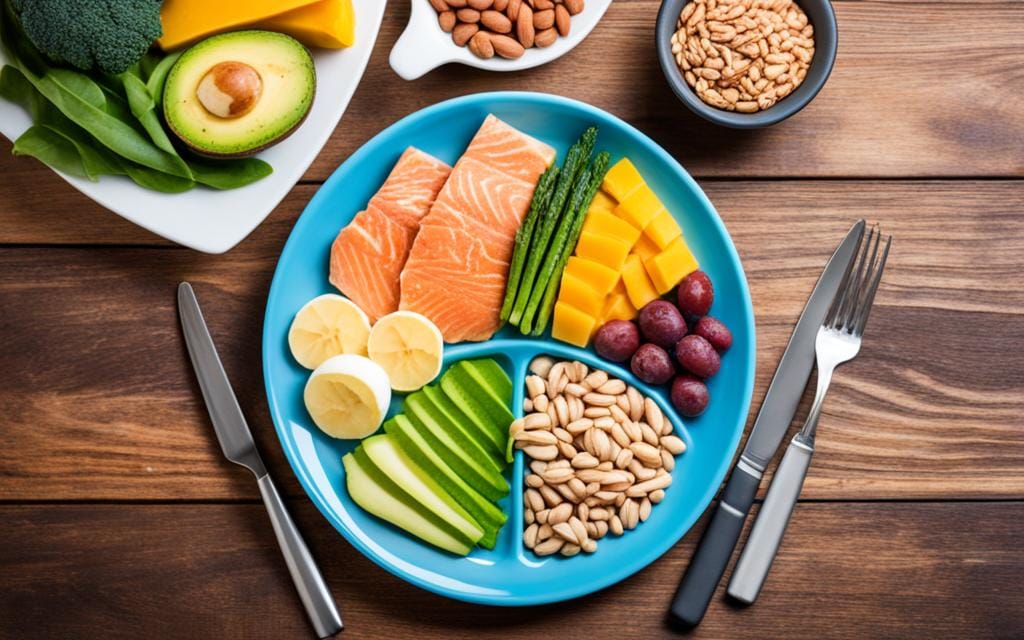
The mix of macronutrients in your diet is key for muscle building. It should have enough protein, carbs for energy, and some healthy fats. This blend is the best for gaining muscle.
Protein Intake for Muscle Growth
Protein builds muscle. It’s vital to eat the right amount to grow and repair muscles. For muscle building, aim to get 1.6 to 2.2 grams of protein for every kilogram you weigh.
A person weighing 150 pounds (68 kg) should get 109 to 150 grams of protein daily to help muscles grow.
Carbohydrates for Energy
Carbs are your body’s main energy source. They’re crucial for boosting your workouts and helping your muscles recover. Try to get 40-60% of your calories from carbs.
Remember to include enough protein and carbs in your diet for muscle growth. This way, you support your fitness goals.
Tracking Calories and Adjusting Intake
Keeping an eye on your calories and nutrients is key for building muscle. It helps you know if you’re eating enough to support growth. This way, you can tweak your food choices and still meet your muscle goals.
A good way to watch your calories is with a tracking app or website. You put in what you eat and how much. Then, it shows you how many calories and nutrients you got. You can change your diet to keep the right energy needed for muscle growth.
Don’t forget to check what kind of nutrients you’re eating too. You need enough protein, carbs, and healthy fats to build muscles well. Some apps even tell you if you need to adjust your nutrient mix.
Over time, you might need to eat more or less to gain muscle. Your needs change as you get stronger. It’s important to keep checking on your goals and adjusting your diet. This keeps you on the right path to building more muscle.
Remember, watching your calories is more than putting in numbers. It’s about learning what your body needs. By keeping track and making changes, you fuel your muscle growth.
Incorporating Exercise for Optimal Results
For muscle gain, eating more is key. But choosing the right exercises matters too. Doing strength training workouts that work on all big muscle groups helps a lot. It boosts the impact of eating extra and helps grow your muscles.
Strength Training for Muscle Growth
Exercise for muscle building is a must for getting bigger muscles. Activities like weightlifting really help. They make your muscles grow more and get stronger.
Here are some key tips for strength training for muscle growth:
- Choose exercises that work lots of muscles together, like squats and pull-ups.
- Keep making your workouts harder by lifting more weight or adding more resistance.
- Rest well between sessions to let your muscles heal and grow.
- Eat plenty of protein to give your muscles what they need to get stronger.
Placing these exercises into your muscle-building plan will get you closer to your goals.
How Many Calories Should I Eat to Gain Muscle?
Figuring out how many calories to eat is key to building muscle. It depends on your BMR and TDEE. In general, you should eat 300 to 500 extra calories to gain muscle without adding too much fat.
To figure out your muscle-building calorie needs, start with your TDEE. Add 300 to 500 calories on top of that. This gives your body the energy it needs for muscle growth.
The best calorie surplus for muscle growth varies for everyone. Some do well with fewer extra calories. Yet, others need more to bulk up. Keep an eye on how you’re doing and adjust your calories as necessary.
| Calorie Intake for Muscle Gain | Calorie Surplus | Muscle Gain Rate |
|---|---|---|
| Maintenance Calories | 0 Calories | No Muscle Gain |
| Maintenance Calories + 300-500 Calories | 300-500 Calories | 0.5-1 lb of Muscle per Month |
| Maintenance Calories + 500-1000 Calories | 500-1000 Calories | 1-2 lbs of Muscle per Month |
To grow muscles, balance food with exercise. Follow a good muscle-building plan. This, along with any tweaks to your calorie intake, will help you reach your goal.
Meal Planning and Preparation Strategies
It’s key to focus on meal planning and preparation for muscle gain. Choose foods that are full of nutrients. This will let you make the most of your extra calories. It will make sure your body gets what it needs to grow muscles and recover.
Nutrient-Dense Food Choices
For muscle gain, pick foods that are rich in nutrients. These foods are powerful for two reasons. They give you lots of calories and provide vitamins and minerals needed for health and muscle growth. Here’s a list of some great foods to eat:
- Lean proteins such as chicken, turkey, fish, and eggs
- Whole grains like brown rice, quinoa, and oats
- Leafy green vegetables such as spinach, kale, and broccoli
- Healthy fats from sources like avocado, nuts, and olive oil
- Starchy vegetables like sweet potatoes and squash
- Legumes, such as lentils and chickpeas
Adding these foods to your meals and snacks feeds your body what it needs for muscle growth. This method makes sure you use your extra calories the right way, helping you build muscles.
| Nutrient-Dense Food | Nutrient Profile | Benefits for Muscle Building |
|---|---|---|
| Chicken Breast | High in protein, low in fat | Provides essential amino acids for muscle protein synthesis |
| Sweet Potatoes | Rich in complex carbohydrates, vitamins, and minerals | Supplies energy and supports recovery processes |
| Spinach | Packed with vitamins, minerals, and antioxidants | Supports overall health and muscle function |
| Almonds | High in healthy fats, protein, and fiber | Provides sustained energy and promotes muscle recovery |
Choosing nutrient-dense foods is a great step toward your muscle-building goals. It also boosts your health in general.
Dealing with Plateaus and Stalls
On the road to muscle-building, we might hit plateaus or slow phases. These times are tough but can be beaten. We just need to tweak our diet, meal proportions, and workout plan smartly.
If we notice we’re stuck, we should first check our calorie intake. Even if we’ve been eating well, it might not be enough anymore. Adding 200-300 calories could be what’s needed to start making gains again.
Looking at our macronutrients is another smart move. Maybe we’ve been too focused on protein. Shifting focus to carbs or fats could be the trick. By mixing up our macronutrient ratio, we can restart muscle growth.
