
Men’s Health and Stress Management: Practical Strategies

Modern life places intense pressure on men across roles as professionals, partners, fathers, and community members. Expectations around performance, financial stability, emotional control, and physical resilience often converge at the same time, creating a sustained level of stress that is rarely addressed openly. Over time, unmanaged stress can quietly erode physical health, mental clarity, relationships, and long-term well-being. This is why men’s health and stress management must be treated as a practical, skill-based discipline rather than a vague concept or a secondary concern.
Stress is not inherently harmful. In short bursts, it sharpens focus and supports survival. The problem arises when stress becomes chronic, unexamined, and normalized. Many men are conditioned to tolerate pressure rather than process it, leading to outcomes such as burnout, cardiovascular disease, sleep disorders, anxiety, depression, and unhealthy coping behaviors. Effective men’s health and stress management focuses on identifying controllable variables, building resilient systems, and applying repeatable strategies that work in real life.
Understanding Stress and Its Impact on Men’s Health
Stress is a physiological and psychological response to perceived demands that exceed available resources. When the brain detects a threat—whether physical, emotional, or social—it activates the sympathetic nervous system. Hormones like cortisol and adrenaline increase heart rate, blood pressure, and glucose availability. This response is useful in emergencies, but harmful when constantly activated.
For men, chronic stress often manifests differently than it does in women. Men are statistically more likely to externalize stress through irritability, risk-taking behavior, substance use, or emotional withdrawal. At the same time, many men underreport stress due to cultural expectations around toughness and self-reliance. This disconnect delays intervention and worsens outcomes.
From a physical standpoint, long-term stress is associated with heart disease, weakened immune function, digestive issues, hormonal imbalance (including reduced testosterone), and chronic inflammation. Mentally, it impairs concentration, memory, and decision-making. Emotionally, it reduces patience, empathy, and relationship satisfaction. Any serious approach to men’s health and stress management must account for this full-spectrum impact rather than treating stress as purely psychological.
Another critical factor is cumulative stress. Men often carry unresolved stress from work, finances, family responsibilities, and unresolved personal conflicts simultaneously. Each stressor alone may be manageable, but together they exceed coping capacity. Recognizing stress as an accumulative load—not a single event—is a foundational mindset shift in effective management.
Physical Foundations of Stress Management
The body is not separate from stress; it is the medium through which stress operates. Without stabilizing physical systems, most cognitive or emotional techniques have limited effect. A core pillar of men’s health and stress management is building physiological resilience.
Sleep is the most undervalued stress regulator. Chronic sleep deprivation elevates cortisol, reduces emotional regulation, and impairs executive function. Men who sleep fewer than six hours per night show higher rates of obesity, hypertension, and mood disorders. Practical sleep management includes consistent sleep and wake times, reducing evening screen exposure, limiting caffeine after midday, and treating sleep as a non-negotiable biological requirement rather than a luxury. Physical activity is another non-optional component. Exercise metabolizes stress hormones and increases endorphins, dopamine, and serotonin. Resistance training supports hormonal balance and self-efficacy, while aerobic exercise improves cardiovascular health and emotional regulation. The goal is not extreme intensity but consistency. Three to five sessions per week of structured movement significantly improves stress tolerance. Nutrition directly affects stress response. Diets high in refined sugar, ultra-processed foods, and excessive alcohol increase inflammation and destabilize blood sugar, amplifying stress reactions. Adequate protein intake supports neurotransmitter production, while micronutrients like magnesium, zinc, and B vitamins play key roles in nervous system function. In the context of men’s health and stress management, food is a lever for stability, not just aesthetics or weight control. Breathing and nervous system regulation deserve specific mention. Slow, controlled breathing activates the parasympathetic nervous system, reducing heart rate and cortisol levels. Simple protocols—such as nasal breathing, extended exhales, or box breathing—can be applied in minutes and produce measurable calming effects. These techniques are especially valuable for men who prefer action-oriented tools over abstract emotional processing.
Cognitive and Emotional Strategies for Managing Stress
While physical regulation sets the foundation, stress ultimately originates in perception and interpretation. Cognitive and emotional skills determine whether a situation is processed as a challenge or a threat. Effective men’s health and stress management includes training the mind to respond more accurately and efficiently.
Cognitive load management is critical. Many men attempt to mentally track too many responsibilities at once, leading to constant low-grade anxiety. Externalizing information—through written plans, task systems, or structured routines—reduces mental clutter. When the brain no longer has to remember everything, stress decreases automatically. Reframing stressors is another core skill. This does not mean denial or forced positivity. It means accurately assessing what is controllable, what is temporary, and what requires action versus acceptance. Chronic stress often persists because energy is wasted on factors outside personal control. Clear prioritization restores agency. Emotional literacy is frequently underdeveloped in men, not due to incapacity but due to lack of training. Being able to identify internal states—fatigue, frustration, resentment, fear—prevents emotional buildup. Suppressed emotions do not disappear; they manifest as physical tension or impulsive behavior. Naming internal states reduces their intensity and improves self-regulation, a key outcome in men’s health and stress management. Mindfulness and attention control are practical, not philosophical. Regular mindfulness practice improves focus, emotional regulation, and stress resilience by training attention. For men who resist traditional meditation, applied mindfulness—such as focused walking, single-task work sessions, or body-based awareness during exercise—can deliver similar benefits without ideological resistance.
Social, Work, and Lifestyle Factors
Stress does not exist in isolation. It is shaped by environment, relationships, and daily structure. Addressing these domains is essential for sustainable men’s health and stress management.
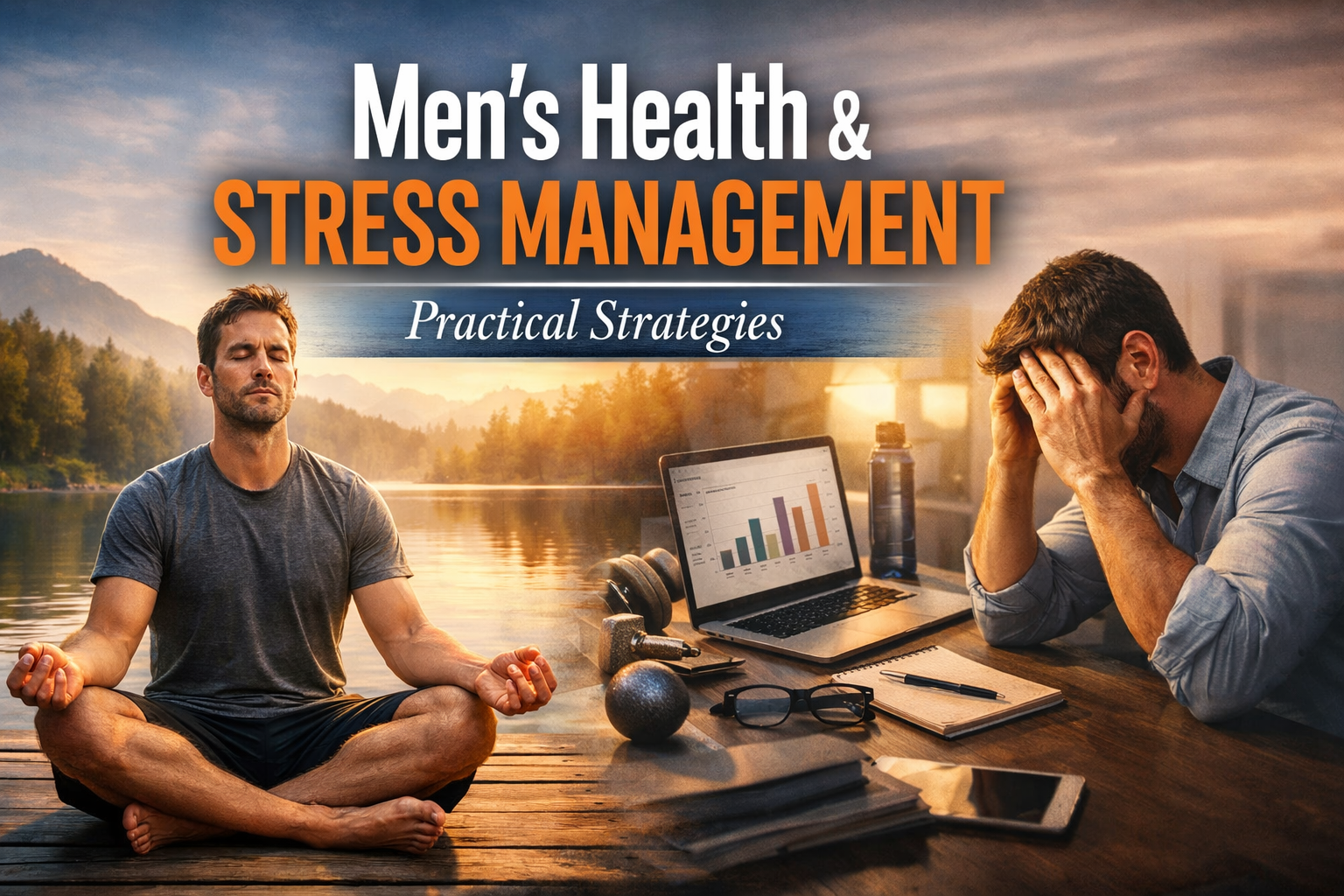
Work stress is a dominant factor for many men. Long hours, unclear expectations, lack of autonomy, and constant digital availability create persistent pressure. Practical interventions include setting defined work boundaries, reducing unnecessary meetings, batching communication, and negotiating realistic workloads when possible. Productivity systems that emphasize output over busyness reduce stress more effectively than time extension. Relationships are both a buffer and a stressor. Strong social connections lower stress hormones and improve longevity, yet many men lack spaces for honest conversation. Maintaining a small number of trusted relationships where vulnerability is permitted is protective. This does not require constant emotional discussion; shared activities, mutual respect, and reliability matter more than frequency of contact. Role overload is another common issue. Men often carry multiple identities—provider, leader, caregiver—without renegotiating expectations as life changes. Stress increases when outdated roles are maintained at unsustainable levels. Periodic role assessment allows adjustment based on current capacity rather than past identity. Digital habits also influence stress. Constant exposure to notifications, news cycles, and social comparison increases cognitive fragmentation. Reducing passive consumption, setting specific times for digital engagement, and protecting periods of uninterrupted focus improve mental stability. In the context of men’s health and stress management, attention is a finite resource that must be defended.
Building a Sustainable Stress Management System
Short-term stress relief is easy; long-term stress resilience requires systems. A sustainable approach to men’s health and stress management integrates habits, environments, and self-monitoring into daily life.
First, baseline awareness is required. Men benefit from tracking sleep, energy levels, mood, and workload patterns. Data reveals trends that subjective memory often misses. Early detection prevents escalation.
Second, consistency over intensity must guide strategy selection. Extreme routines fail under pressure. Simple, repeatable behaviors—daily movement, regular meals, fixed sleep windows—outperform complex plans.
Third, periodic stress audits help recalibrate. Assessing what is adding stress, what is reducing it, and what is unnecessary allows intentional course correction. Stress management is not a one-time fix but an ongoing process aligned with life stages.
Finally, professional support should be normalized. Coaches, therapists, physicians, and trainers provide external perspective and accountability. Seeking support is not a failure of self-reliance but an optimization strategy. Effective men’s health and stress management recognizes when internal resources are insufficient and supplements them intelligently.
Conclusion
Stress is an unavoidable component of modern life, but chronic unmanaged stress is not. For men, the cost of ignoring stress is high, affecting physical health, mental performance, relationships, and longevity. A practical approach to men’s health and stress management treats stress as a systems problem rather than a personal weakness.
By stabilizing physical foundations, training cognitive and emotional skills, optimizing social and work environments, and building sustainable routines, men can significantly reduce stress load while increasing resilience. The goal is not to eliminate pressure but to develop the capacity to meet it without deterioration.
Men who invest in structured stress management do not become less driven or capable. They become more consistent, clear-headed, and durable over time. In that sense, men’s health and stress management is not a retreat from responsibility, but a strategic commitment to long-term performance and well-being.
