Founder of India’s Gen-Z ‘Cockroach’ movement detained ahead of planned protest, party says

Daftar Isi
Detentions Hit Youth-Led “Cockroach” Movement Before Delhi Protest
Activelifezero.com – Police detained Abhijeet Dipke, the founder of India’s fast-growing Cockroach Janta Party, after boarding his aircraft when it arrived in New Delhi on Saturday. The move came shortly before supporters were expected to gather in the capital for a new round of demonstrations aimed at the country’s election authorities.
Dipke was taken into custody alongside other party leaders, the group said. Video circulated by the CJP showed officers entering the plane shortly after landing, as Dipke addressed the situation from his seat.
“The entire Delhi police team is boarding the aircraft,” Dipke said.
“This is dictatorship, with Delhi police entering the plane and trying to arrest us,” he added. “Come on, arrest us… we are not afraid of you. Go ahead and arrest us! Victory to Mother India! Long live the revolution!”
The party described the detentions as an attempt to stop organizers before they could reach the planned gathering. It said the action was intended to weaken the leadership of peaceful demonstrations in advance.
Dhruv Rathee, a prominent activist and online creator with 33 million YouTube subscribers, was also detained at the protest location, the CJP said.
A Second Act for an Unusual Political Force
The planned action was presented as “Season 2” of a movement that began only months ago as a Gen-Z internet joke. Since May, the CJP has developed into a visible youth-focused campaign, mixing social-media organizing with street protests and demands for political accountability.
Its unusual name emerged from a controversy involving India’s chief justice. In May, he was accused of describing groups of unemployed young people as “cockroaches” and “parasites.” He later said his remarks had been misrepresented. Dipke, a Boston University graduate, turned the disputed language into the movement’s central symbol, emphasizing the insect’s resilience and ability to endure.
The group soon became involved in nationwide protests over an exam paper-leaks scandal. Demonstrators demanded that Education Minister Dharmendra Pradhan leave office, while wider frustrations over limited opportunities for young people fueled the campaign.
Its online presence helped set it apart from traditional parties. Videos from protest sites showed dancing, DJs, satirical songs aimed at Prime Minister Narendra Modi and calls encouraging viewers to leave their phones behind and participate. Organizers also distributed free meals, attracting so many food donations that they eventually asked supporters to stop sending supplies.
After weeks of marches and sit-ins, Pradhan stepped down. The resignation marked an uncommon setback for Modi’s government and delivered an outcome that more established opposition groups had struggled to achieve.
Election Commission Becomes the New Focus
Saturday’s planned protest centered on Gyanesh Kumar, the 62-year-old head of India’s Election Commission. The commission is overseeing a major effort to remove deceased, duplicate and otherwise ineligible names from voter lists.
Opposition parties have accused the commission of removing eligible voters in a way that could favor Modi’s Bharatiya Janata Party. The BJP and the commission reject those allegations. For the CJP, the issue has become a test of whether citizens can trust the administration of elections in the world’s largest democracy.
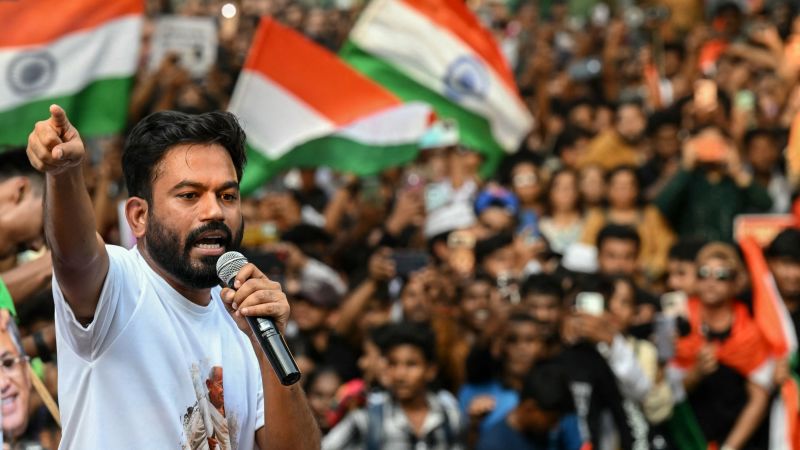
More conventional opposition parties have voiced similar objections, but Dipke called CJP supporters to Jantar Mantar, a longstanding protest site in central New Delhi. Organizers had hoped that tens of thousands would attend.
By mid-morning, however, the crowd had not reached the size seen at earlier demonstrations. The lower turnout followed extensive security measures across the capital. Central Delhi was sealed off, mobile internet access was blocked, and police detained many people who had reached the protest area.
The CJP said Friday that police in several states had detained thousands of its supporters. India’s interior ministry ordered the internet shutdown in central Delhi through 10 p.m. local time Saturday.
Clash Over Protest and Political Legitimacy
The ruling BJP sharply criticized the movement. Nitin Nabin, the party’s president, accused the CJP of seeking to disrupt a country that was becoming more self-reliant and empowered.
“You cannot bear to see India moving forward as a self-reliant and empowered nation, and you are attempting to destabilize it at the behest of foreign forces,” Nabin wrote on X.
“Let me state clearly: Indian democracy possesses immense strength, and the patriots of this nation will unite to thwart your designs.”
The confrontation illustrates the growing influence of digitally organized youth activism in India. The CJP’s rapid rise has shown how online culture, humor and viral content can be converted into real-world political participation. It has also demonstrated the risks faced by movements whose influence expands faster than their formal structures.
For supporters, the detentions and restrictions became part of the message: that public protest and voting rights require active defense. For critics, the party’s confrontational style and rapid mobilization raise concerns about instability and misinformation. The dispute over voter-roll revisions will remain especially consequential because even technical changes to electoral registers can affect public confidence in an election system serving hundreds of millions of voters.
Whether “Season 2” produces crowds on the scale organizers envisioned remains uncertain. Yet the movement’s first campaign showed that a political force born from an online joke can still force attention onto issues that established institutions might prefer to contain.
Related Reading
Frequently Asked Questions
What is Founder of India s Gen Z Cockroach?
Founder of India s Gen Z Cockroach is the main topic of this guide. The article explains the context, practical details, and next steps readers should understand.
Why does Founder of India s Gen Z Cockroach matter?
Founder of India s Gen Z Cockroach matters because readers are looking for a useful answer, not just a short summary. Good content should match search intent and help them decide what to do next.