Aircraft carrier USS Abraham Lincoln arrives in Thailand after months of combat in Middle East

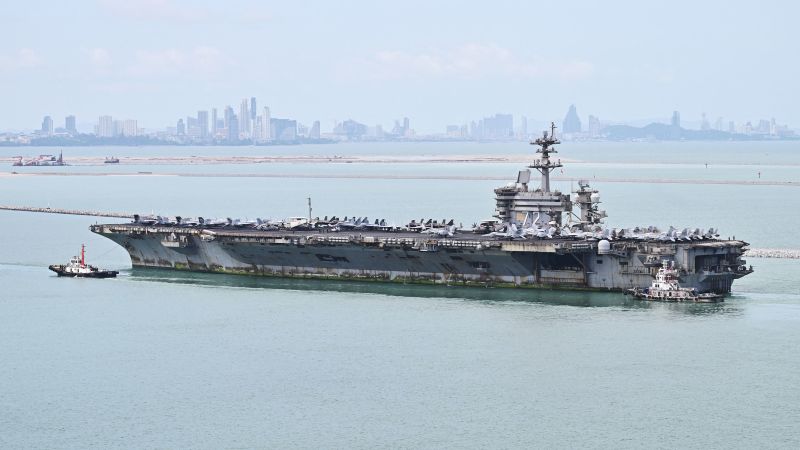
USS Abraham Lincoln Arrives in Thailand After Combat
Activelifezero.com – The aircraft carrier USS Abraham Lincoln slipped into the port of Laem Chabang on Wednesday, ending one of the longest continuous sea deployments in modern U.S. naval history. The 100,000-ton ship had not entered a friendly harbor since leaving San Diego last November, and its docking near the Thai resort city of Pattaya marks the first shore visit of a mission that will extend well beyond any recent precedent before the vessel eventually returns to Southern California later this year.
Capt. Dan Keeler, commanding officer of the ship, framed the arrival in terms of institutional pride rather than personal relief.
“We are all very excited to make Thailand the first port visit on our historic deployment,” Keeler said in a statement.
A Record Stint in Active Combat Waters
The Lincoln’s months at sea have not been routine patrol work. U.S. Sen. Richard Blumenthal, a Connecticut Democrat on the Armed Services Committee, noted that the carrier set a modern benchmark for consecutive days spent in active combat and blockade operations against Iran. For a crew of roughly 5,000 sailors and Marines, that distinction carried a bitter edge: the extended mission coincided with documented morale deterioration, shortages of basic consumables, and at least one possible suicide attempt aboard.
Blumenthal took his concerns directly to the Pentagon last month, writing to Defense Secretary Pete Hegseth and the acting secretary of the Navy to demand answers about living conditions on the ship. His letter catalogued a litany of problems.
“There have been widespread reports of shortages of basic supplies, water contamination, plumbing issues, deteriorating mental health, deck safety concerns,” he wrote, adding that “disruptions in the mail system” had caused care packages destined for the vessel to be lost in transit for months.
Hegseth pushed back publicly, declaring that conditions aboard had been “completely misrepresented,” though he offered no specifics about which elements of the reporting he found inaccurate. President Donald Trump, pressed on the length of the deployment, waved off the concern entirely, remarking that the mission was “not nearly long enough.”
Strategic Ripple Effects of a Two-Carrier Commitment
The political friction over crew welfare arrived alongside a quieter but consequential operational shift. Once reports of the Lincoln’s deteriorating conditions became public, the Pentagon moved the Japan-based carrier USS George Washington into the Middle East theater to relieve the ship. The George Washington has since assumed station there alongside the USS George H.W. Bush, preserving a two-carrier posture for the Navy while hostilities with Iran continue.
Analysts and defense critics quickly pointed out the cost of that redeployment. Pulling one of the Navy’s largest nuclear-powered carriers out of the Western Pacific removed a visible instrument of alliance reassurance and extended deterrence aimed at China and North Korea. The episode, they argued, exposed how thin the service’s carrier margin has become when a single prolonged engagement in one theater consumes assets earmarked for another.
Adm. Daryle Caudle, Chief of Naval Operations, addressed the strain directly while speaking to reporters in Virginia last week. He acknowledged that extended deployments exact a toll on sailors and their families and pledged that the Navy would seek greater predictability in rotation schedules, while conceding that wartime exigencies complicate any fixed timetable.
“I would prefer, you know, seven-month deployments. I typically am not a big fan of extensions, and I push back hard on that. But the enemy gets a vote,” Caudle said, as quoted by USNI News.
Two More Warships Join the Thai Port Call
The Lincoln is not alone in Thai waters. The guided-missile destroyer USS Frank E. Petersen Jr. docked Wednesday at Sriracha, a short distance from Laem Chabang, while the guided-missile cruiser USS Robert Smalls arrived at Map Ta Phut, east of Pattaya. Together, the three vessels represent a visible slice of American naval presence in the Gulf of Thailand, a region that has hosted U.S. warships intermittently for decades.
The choice of a Pattaya-area port is not incidental. During the Vietnam War, the Thai coast became the principal rest-and-relaxation corridor for American servicemembers rotating out of combat. Pattaya, less than an hour’s drive north of the U-Tapao airbase, grew into a raucous destination where troops unwound from the pressures of jungle warfare. That legacy of military traffic has kept the region’s port infrastructure familiar to Navy logistics planners ever since.
Frequently Asked Questions
Why did the USS Abraham Lincoln stop in Thailand?
The carrier made its first port call of the deployment at Laem Chabang to allow crew rest, resupply, and maintenance after months of continuous operations in the Middle East. Thailand’s established port facilities and proximity to U.S. logistics routes make it a practical interim stop.
How long had the ship been at sea before arriving in Thailand?
The vessel departed San Diego last November and had not entered a friendly harbor until the Laem Chabang docking, making the stretch one of the longest continuous deployments in recent Navy history.
What other U.S. ships are in Thai waters?
The guided-missile destroyer USS Frank E. Petersen Jr. is at Sriracha and the guided-missile cruiser USS Robert Smalls is at Map Ta Phut, placing three U.S. warships in the Gulf of Thailand simultaneously.
What happened to the carrier’s original theater assignment?
The Pentagon redirected the Japan-based USS George Washington to the Middle East to relieve the Lincoln, maintaining a two-carrier posture alongside the USS George H.W. Bush while operations against Iran continue.