Drones are the latest buzzy tech aimed at stopping a school shooting. They’re part of a billion-dollar industry

Daftar Isi
A Billion-Dollar Shield: How Parents, Policy, and New Technology Are Reshaping School Safety
Activelifezero.com – The question that haunts American parents no longer asks whether a school shooting will happen, but how quickly the response will arrive. That anxiety has fueled a multi-billion-dollar security apparatus stretching from metal detectors at front entrances to remotely piloted drones capable of breaching a classroom window and neutralizing an armed intruder within sixty seconds. The industry’s annual footprint, by one estimate, lands between $3 billion and $4 billion when drones, school resource officers, screening equipment, and related infrastructure are tallied together.
Justin Marston, co-founder and CEO of Campus Guardian Angel, puts the figure at the higher end of that range. The Urban Institute, a nonpartisan think tank, calculated that school resource officers alone consumed $2.62 billion in fiscal year 2023. Behind those numbers sits a simpler, more painful driver: families who lost children in mass shootings have become the most persistent advocates for layered security measures, pushing districts and state legislatures to fund technologies that did not exist a decade ago.
“I think every parent will want to feel that there is some type of capability at their child’s school to confront and stop an active shooter threat versus having to wait the five to eight minutes for the police to get there,” Marston said.
The Drone as First Responder
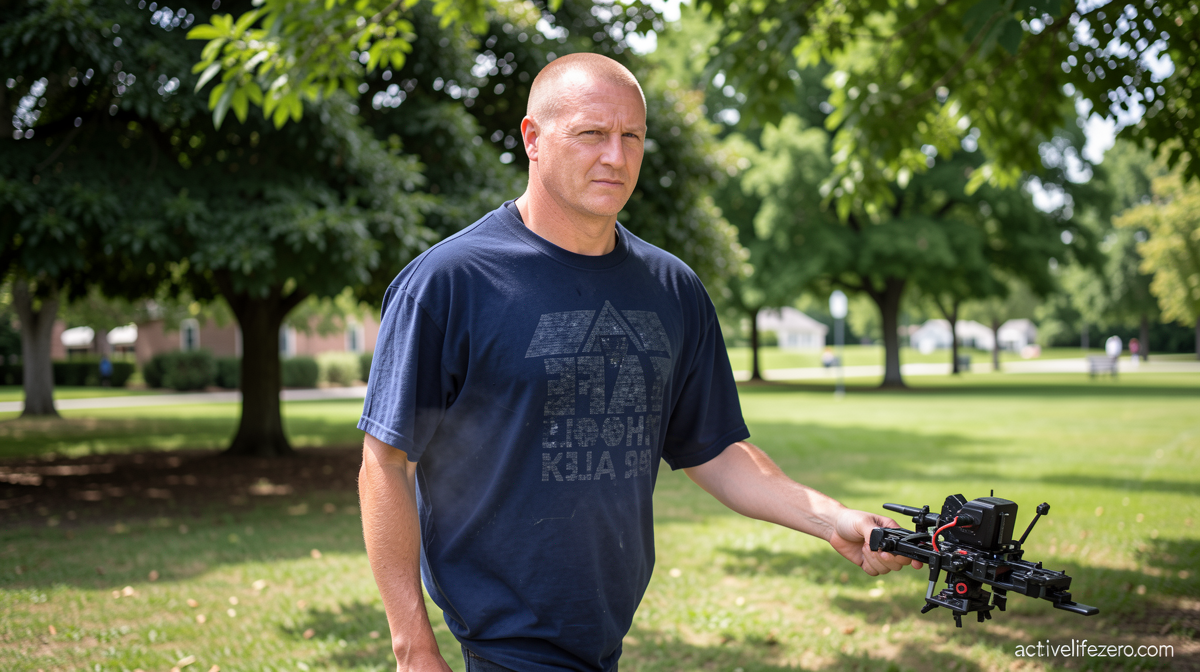
Campus Guardian Angel’s product is, in Marston’s own words, a “lump of plastic.” Yet that compact airframe is launched remotely, punches through glass, sweeps a classroom for threats, and carries an embedded speakerphone that lets teachers and responding officers talk to occupants in real time. Mounted point-of-view cameras stream live video back to law enforcement, giving commanders situational awareness before boots hit the floor. The entire sequence—from launch to incapacitation of a shooter—targets roughly one minute.
The technology is already operational in three Florida counties, where state allocations exceeding $1 million helped underwrite the rollout. Five Georgia schools received the drones through funding approved by the state legislature. This month marks the first Colorado deployment, and Marston indicated that Texas districts have expressed interest and are exploring financing pathways. Each of those four states carries the scar tissue of a high-profile school massacre: Parkland, Apalachee, Uvalde, and Columbine.
The Colorado site where the drones will operate sits in the same county as a 2019 incident in which two shooters killed one student and wounded eight others—a reminder that proximity to past tragedy often accelerates adoption of new safeguards.
From Parkland to Policy
Jennifer DePaoli, a senior researcher at the Learning Policy Institute, an education research and policy advocacy nonprofit, identifies the 2018 shooting at Marjory Stoneman Douglas High School in Parkland, Florida, as the inflection point that supercharged the industry. Seventeen students and faculty members were killed that February morning, triggering a national reckoning with gun violence on campuses. In the months that followed, states injected at least $960 million into student-safety programs, according to The 74, a nonprofit news outlet focused on U.S. education.
One concrete legislative outcome of Parkland is Florida’s Alyssa’s Law, named for Alyssa Alhadeff, a 14-year-old student killed in the shooting. Her parents helped draft the statute, which mandates that public schools install a silent panic-alarm system wired directly to local law enforcement. Proponents argue the system compresses response times during gun violence or medical emergencies. Lori Alhadeff, Alyssa’s mother, now lobbies for adoption of equivalent systems in schools across the country. Twelve other states—New Jersey, New York, Texas, Tennessee, Utah, Oklahoma, Louisiana, Georgia, Washington, Oregon, Virginia, and West Virginia—have since enacted their own versions.
“School Hardening” and Its Limits
Alyssa’s Law is one strand of what security planners call “school hardening”: the physical fortification of campus perimeters and interiors. Metal detectors, automatic door locks, and surveillance cameras have been standard fixtures at schools nationwide for years. Yet the record shows these layers are not impervious. Students have slipped past malfunctioning metal detectors or simply entered through an unlocked secondary door. In January 2025, AI-powered gun-detection software—one of the newest additions to the toolkit—failed to flag a student’s weapon before he killed a 16-year-old girl at a Nashville school and then fatally shot himself, district officials confirmed at the time.
Those failures underscore a tension at the heart of the industry: no single technology, however expensive, guarantees safety. What parents and policymakers increasingly seek is redundancy—multiple overlapping layers so that if one fails, another holds. The drones, in that framing, are not a replacement for trained officers or locked doors but an additional node in a chain designed to shave seconds off the response clock.
As deployment expands from Florida’s three counties into Colorado, Texas, and potentially beyond, the practical question shifts from “should schools invest in layered security?” to “how do districts fund and maintain it without diverting resources from instruction?” The answer will shape whether the next decade of school-safety spending produces measurable reductions in casualties—or simply a more expensive version of the same gaps.
Related Reading
Frequently Asked Questions
What is Drones are the latest buzzy tech?
Drones are the latest buzzy tech is the main topic of this guide. The article explains the context, practical details, and next steps readers should understand.
Why does Drones are the latest buzzy tech matter?
Drones are the latest buzzy tech matters because readers are looking for a useful answer, not just a short summary. Good content should match search intent and help them decide what to do next.